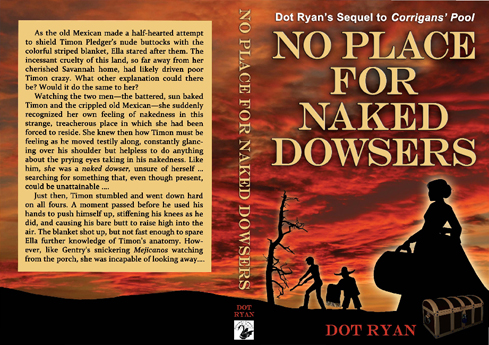
SEQUEL: LEAVING CORRIGANS' POOL (On A Rough Road To Reality): PART ONE
Upcoming Sequel to Corrigans' Pool
(Release date: Summer of 2012)
Title:
LEAVING CORRIGANS' POOL
(On A Rough Road To Reality)
By Dot Ryan
(Part 1 of 3 Parts)
Prologue
G
ENTRY GARLAND STOOD ON THE BLUFF overlooking GreenpoolePlantation,his sunburned face void of emotion,
his black eyes unreadable. Only the rapid drumming of fingers against his
leather-encased thigh gave way his turbulent thoughts: It was time to tell his
wife that the Georgia home she so revered was not for him ... would never be
for him. Even had the war not changed things in the South, this place would not
have been for him; he had been foolish to think it could be. He had been more
foolish to let love for his wife over-rule his common sense. Ella's dream of restoring
Greenpoole to its old splendor had become his nightmare, and he was tired of
pouring "good money after bad."
He
lit a thin cheroot and tossed the match over the bluff into the river. As
beautiful as Ella's Greenpoole plantation on the Savannah River still was in
many ways, the scars of war and poverty were everywhere. The end of slavery
meant the end to prosperity to planters such as the Corrigans ... an end to "the
old days" that Ella, and others like her, spoke of with such longing. Her
sharecropping adventure with her freed Negroes—trading crops for labor—was a
failure that she refused to acknowledge. Her share of those crops was never
enough to pay the bills. Blind to reality, she and fellow planters refused to
see the hopelessness of their efforts: Southerners across the entire South were
starving on a new diet of higher and higher taxes; their land, animals, and
goods of all types, confiscated for nonpayment. Conditions were the same in
Texas for ex-Confederates and their supporters. Disenfranchisement—men stripped
of their voting rights—left Southerners no voice. Without the vote, there was
no sane way to fight the injustices leveled by land grabbers whose identities
had never been Southern—the politics of the day giving them sovereignty over their
victims. As proof that injustice—whether real or perceived—often bred insanity
in those prone to violence, clandestine societies of mostly ex Confederates
sprang up in nearly every Southern community ... bands of hooded men on
horseback terrorizing black and white alike, setting ablaze crude wooden
crosses ... hanging and burning terrified Negroes, as well as their white
sympathizers.
Gentry
wanted no part of this postwar turmoil. He had fought for neither North nor
South and, like many Texans who clung fiercely to their individuality; he
considered his isolated land along the winding Guadalupe River a perfect divide
from both arguments. There, he and his little family could be lost from the
rest of the world if that's what they wanted ... all the while prospering from
a new inventive—trailing, and then selling, his thousands of longhorns at
distant markets like Abilene, Kansas where the animals were fetching fifteen to
twenty-five dollars per head. Before the war, his three parcels of ranchland, fifty
thousand acres per parcel and with a major river—the Aransas, Guadalupe, or San
Antonio River running through one or the other—had been populated by thousands
of his longhorns and almost as many horses. When droughts hit, he and his men
simply drove the cattle overland to the next parcel where the river was still
full and left them there until, eventually, rain solved the drought problem,
filling the rivers and growing the grasslands. So far, his acres were still
intact—It was the slow, steady drain of his once vast herds that worried him.
He
had returned to Texas four times in the past two years to sell off more and
more of those cattle and horses—all to keep Ella from losing Greenpoole. With
each brief appearance at his ranch, his vaqueros and their families eyed him
with unspoken questions, undoubtedly wondering if he had gone loco. Only the
ten-year-old boy, Erasmo, had the gumption to speak up.
"Is
it for your bruja far away, Senor Garland that you must sell these cattle?" he
said, his innocent brown face naked with concern. "Mama says that soon this
bruja will have you sell the ranchero also, and we will have no more work and
no more roof above our heads."
Figuring
that Erasmo only repeated the talk that circulated among his ranch hands of
late, Gentry had not scolded the boy. But before he
left again for Georgia, he told Erasmo that someday he would bring his mujer to Texas and the boy would then discover that she
was an angel, not a bruja ... an angel,
who had bewitched him long ago.
His heart had not changed, nor
was his love diminished by his mounting disgust for his wife's delusions about
Greenpoole: It was his spirit that had been diminished, leaving him with a
feeling of cravenness that he had never before experienced; his reaction to it
was silent anger. With each passing day, he struggled harder to restrain
that anger.
His
foul-mouthed old friend, Hempstead Grouse back in Texas, said he was the worst
kind of "whupped" that can happen to man.
"And
out of respect fer your lady, Gent, I ain't mentionin' the part of her anatomy that's
got you so goddamned whupped."
Had
any man, other than Hempstead, made such a remark, he would have
landed on his back in the dirt while spitting out a mouth-full of bloody teeth.
But Gentry knew if he struck the wiry old desperado turned lawman, odds were he
would just have to go ahead and kill him, for the bad-tempered old cuss would
have done his best to kill him.
Anyway,
Gentry doubted if Hempstead, a hard-bitten old bachelor "in
loathe of female situations", would understand his reasons for pampering
Ella. Her marriage to Victor Faircloth was his fault. His fault that the letter
he wrote to her fell into the wrong hands. Had she gotten that letter, her
years of misery would not have happened—but all she had known at the time was
that he had made love to her ... took her virtue beneath the moonlit oaks
alongside Corrigans' Pool ... then left town early the next morning without a word ... leaving behind only the note that
the love-sick—sorry excuse for a preacher—Timon Pledger, stole before it could
reach Ella's hands. What else was she to think other than he had callously used
her and then jilted her? Afterward, the cruelties of the man she then married
had all but killed the young woman he had fallen in love with. Four long years
later, on the day he and Ella finally wed, he had silently vowed to do all
within his power to heal her so completely that not one scar remained. An old misogynist like Hempstead Grouse would never understand
loving a woman that much.
For the most part, he had
succeeded in making Ella happy. She was forgetting the hard past, was never more
beautiful than now, never more able with a glance to set his heart to jumping. But
he did not fool himself that the gladness in those blue-green eyes was as much
for Greenpoole's resurrection as for the newly rekindled love between them. He
was almost ashamed of his secret pleasure when another batch of sharecroppers
didn't work out as she planned or when it rained too much or not enough and her
cotton crops perished—glad, even when it was his money being plowed under,
every dollar of cattle revenue he provided swiftly gobbled up by that hopeless
dream of hers. And now, after last years meager cotton harvest, Ella wanted to
resurrect the tidal rice lands that her deceased father wisely abandoned ages
before the war started! The steaming rice swamp was "drudge work"—a man's least
desirable way of making a living, and Ella's workers were abandoning the swamp
in droves. Aside from backbreaking labor, there slithered beneath those marshy
acres of twisted undergrowth denizens of venom and sickness ... of a kind that
the newly freed Negroes—now able to choose how they lived and died—were little
inclined to embrace. Ella's tempting offers of land, to be deeded those who
would work in the rice marshes for five years, had no effect on their decisions
to leave. With not enough takers, Ella would have to give up on the rice soon.
Maybe when her few remaining sharecroppers followed their predecessors into the
cities, she would see the hopelessness of this damned scheme to prosper from
the soil "like in the old days." Even with the
help of the family's venerated matriarch, Beatrice Corrigan, he had been unable
to make her understand that politics, taxes, and the punitive spirit of
radicals in congress stood like an impregnable barrier to Southern dreams of
recovery.
There
was something mighty sad about folks who live so much in the past that they can't
get their feet moving toward the future. In that respect, Ella was a lot like
his mother. Kate Garland was stubborn, unrelenting in her efforts to hold on to
the past. He wanted her to sell her land along the Nueces River near Corpus
Christi, and move to his ranch seventy miles north. Incensed, she cried "never!"
Staying on the land that his father had fought and bled for, kept her wild
Irish-Indian husband alive ... kept "the old days"
alive in her memory, which was all that was left of Kiel Garland.
Gentry's jaw tightened. He'd
once though he was a man like his father—fierce in his beliefs ... unyielding
in what he knew was right. Maybe he should do what Kiel did over thirty-five
years ago when he set out to claim his bride. Gentry half-smiled despite his
foul mood. Since boyhood, he had heard the story dozens of times from first
one, and then the other, of his parents. He liked his mother's account best.
She spoke of their "takin' to one
another" with the lilting laughter of the strong-headed Irish girl she had
been in the spring of 1835, when young Kiel rode silently into the Irish
settlement of San Patricio along the Nueces River and carried her away while
her clueless parents slumbered in the next room.
But
Kate had been a willing conspirator, full of determination and knowing every
minute what she wanted and who she wanted—a woman whose heart, once set, never
changed since the first day she and Kiel laid eyes on each other in her father's
general store. Was Ella's heart set? He wasn't sure. He was certain of only one
thing; he had a rival—Greenpoole Plantation.
The
red glow on Gentry's cheroot went out; he relit it and flicked the match into
the wind. He had been silent in light of Ella's happiness at Greenpoole,
relishing her laughter that had come so easy, until problems with her
sharecroppers began to worry her. At the beginning of those troubles, he should
have tried to convince her that the prosperity she wanted lied in his thousands
of cattle and horses—not cotton!
He
turned slowly and gazed all around him, but instead of seeing Greenpoole's
tree-lined acres and the beautiful old Savannah River rippling past between
delicately shimmering walls of vine-hung foliage, he saw a vast rolling prairie
spattered with oak motts and knee-high prairie grass melting into infinite
fields of bluebonnets, sunflowers, Indian blankets, and buttercups. A vast herd
of wild horses thundered into his vision, and beyond them hundreds of
long-horned cattle stepped warily from a wide patch of Mesquite brush to graze
upon the peaceful open range.
After a moment, Gentry sucked
deeply on the cheroot, and then spewed the smoke from between his tight lips as
if he had tasted something foul. Slowly and steadily, there came into his black
eyes a look more reminiscent of the "old
days" and the old Gentry Garland.
He took another drag from the cheroot before tossing it over the bluff's edge
into the river. He'd wait until this last crop was in, and then he'd tell his
wife to pack their duds, because he was taking her and his son home to Texas.
Part I
Chapter1
"W
HAT DO YOU MEAN, HONOR, 'WHEN WE'VE PACKED UP and gone from this place?' Explain yourself, please." Ella almost whispered the words, and then stared at her younger sister. Surely,
Honor could not be serious! If so, the girl had no more sense now—a married woman
and the mother of a three-year old daughter—than when a child-like,
fifteen-year-old girl all too giddy with a desire to wed her irrepressible
beau, Andy Kearney. Ella looked at their grandmother, Beatrice Corrigan,
expecting her to be as shocked as she was at Honor's silly remark, but no sound
came from the woman. Not even a derisive hoot! Ella continued to eye the
elderly woman whose owl-like eyes—like the steely orbs of an aloof
wizard—continued to gaze elsewhere. Surely, she would say something upon
hearing such twaddle. The Beatrice Corrigan that Ella knew had a rejoinder for
every conversation within her hearing range, invited or not.
Finally,
Ella gave up and leaned forward to face her sister, determined to speak softly,
knowing if she let her emotions escape, the colossal empty room would echo her
words like stones striking the walls of an iron well. "I'm waiting to know what you meant by that
ridiculous statement, Honor. Surely the notion that we would leave Greenpoole
must have come from somewhere."
Honor
glanced fearfully at Ella and then at their grandmother, who still ignored them
both. Honor quickly shifted her attentions to the small girl draped across her
lap and began poking nervously at the girl's blond curls. The child immediately
slid into a sitting position on the floor and scooted on her tiny rump until
she was out of her mother's reach. When Honor motioned for her to return, the
child entangled her fingers in her curls and stuck out her bottom lip. Honor
giggled. "She thinks I'm gonna comb her tangles out."
"Honor
...," Ella persisted.
Honor
again looked to their grandmother, but Beatrice stiffened her chin against her
high lace collar, as if to say 'you got yourself into
this, young lady, now get yourself out of it.'
Honor
sighed. "I only meant that maybe ... someday ... we might all just move into
Savannah with Grandmother ... like she keeps telling us we ought'a do." She
hesitated, then blurted, "Grandmother says we'll never be able to turn this
place around ... 'cause God and those hateful politicians in Washington won't
let us."
Ella
stared at her for a long interval and then settled back against the hard wooden
chair. "You and Andy may go whenever you wish. I won't abandon Greenpoole to
the sharecroppers. How would the work get done without Gentry and me
encouraging them? Besides, I have Hannah and the others to think about. Old
Baker Ben says he will never leave, nor will Cricket and the twins." She paused
to note that neither woman was looking at her, "... and
since Meshach was unable to abide the North and has come home, I intend to make
him Greenpoole's overseer—the crops are bound to improve."
She waited for
her two companions to agree. When neither spoke, she continued, "Meshach and
the others love Greenpoole, just as I do and just as—"she glanced up from her
sewing and looked sternly at first one and then the other, just as the two of you should love it, she wanted to say,
but instead said, "just as Father and all Corrigans before him loved it. They would have never left simply because life got a bit
harder."
"A
bit harder, you say?" Beatrice finally spoke. She took a sip of tea then
balanced the cup in her free palm, her sour expression deepening as she looked
around the room. "I know the tables are gone—firewood for General Sherman's
army in ought-four or later sold for Greenpoole's upkeep—but have you not
another chair on which to set our repast?" Knowing the answer, she continued. "You
know good and well, Ella, that Hannah and the others, except for old Bake Ben, would
gladly follow you to town or anywhere else. Tis you who refuse to
leave."
"That
is the very truth," Honor chimed, nodding in agreement, as she jerked her
attention from Beatrice to Ella and then back to Beatrice, apparently expecting
the usual fireworks between her older sister and their domineering grandmother.
But Ella spoke softly.
"You
have so many lovely old tables and other treasures in your attic, Grandmother.
Seems you would have sent them out here to Greenpoole by now, knowing our need."
Beatrice
sipped at her tea, her weathered cheeks tightening as she gazed
over the cup's rim. "You and your sister may divide my property between you,
dear girl, when I am dead and buried. Until then, I shall keep my treasures
where they are."
Honor
leaned far out of her chair to deliver a hurried pat to Beatrice's knee. "In
that case, Grandmother, I hope those lovely pieces of furniture stay where they
are for a very very long time ... even if we do need them terribly . . . and your poor
little great-grandchildren would be so much more comfortable."
Beatrice
glowered at her, and then switched her gaze to Ella. "Your husband tells me
that Greenpoole's taxes have increased and are due weeks before harvest ... a
harvest that will not be sufficient to pay them, just as last time."
Ella
set her cup firmly in its saucer. "I'm surprised Gentry spoke to you of that
matter, Grandmother. I've never known him to complain."
"He
was not complaining, dear girl, and why shouldn't he speak to me, his elder,
and his friend? Anyway, he is a cattleman, not a planter—perhaps he sought
wiser council than has been his privy of late." She ignored Ella's sudden
frown. "As a former planter and eternal realist, I advised him to the best of
my awareness and experience."
"May
I ask what advice you gave him?"
"You
may ask." She sipped her tea again before delicately replacing the cup on its
saucer, scarcely making a clink. "I suggested he follow his heart ... as long
as it did not bog him down in a quagmire of malcontent."
Ella
smiled. "Thank you, Grandmother, because my husband does, indeed, follow his
heart, and I am most fortunate that his heart is with me and here at
Greenpoole, where it will always remain. There is no 'quagmire of malcontent'
here," she added, ignoring that the two women glanced brief at each other.
* * *
At dusk, Ella stood on her balcony watching
the red sun sink into the river and waiting for Gentry to come home. In the
back of her mind was her grandmother's insinuation. Had Gentry disclosed
feelings to Beatrice that he had yet to reveal to her? Oh, but he would never
do that! If Gentry thought of moving them into town, he would have said so by
now. Besides, he knew they couldn't run Greenpoole while residing seven miles
away in Savannah. Even with Meshach in charge, they'd need to be here. Why,
they'd wear themselves out traveling back and forth every day, for Heaven's
sake!
The
stunning red sunset shimmered across the river like liquid rubies, but Ella
turned her back to it and pressed her knuckles to her lips, her mind racing, as
she hurried back into her room. Gentry's in Savannah more than usual lately and
seems so restless at times. Some days his moodiness made her so uncomfortable
that she had to force her thoughts elsewhere—there were so many crucial matters
to ponder that she did not have time for...
Her
concentration turned automatically to the new tax notice in the bureau drawer.
She'd have to ask Gentry for more money. Oh!
How she wished Beatrice had not come to visit today! She frowned then glanced
sidelong at herself in the mirror, wincing at the plainness of her dress ...
the severity of the way she now wore her long hair in a tight bun on the nape
of her neck. She looked so plain ... almost angry. Did Gentry find her
unattractive? Subconsciously, she loosened the bun and let her thick blanket of
pale hair fall to her waist. Was he glum because she no longer went out of her
way to make herself pretty for him? But when did she have time to preen her
feathers when they both worked themselves to the point of exhaustion each day?
Or was he sullen because she neglected him, falling asleep as soon as her head
hit the pillow, sometimes so tired she pretended to be asleep, ignoring his
touch until he gave up and rolled away from her.
Without
further thought, she jerked the cover from her huge copper bathtub, lamenting
only briefly over how General Sherman's men had taken the tub's beautiful Rocco
base when they occupied Greenpoole late in the war. She emptied into the tub
the six large buckets of cool water that Hannah and the twins kept filled to
their brims for her bath.
After
rummaging through several drawers for a forgotten pouch of coveted bath salts,
she peeled away her sweat-soiled garments and sank gingerly into the cool,
spicy water. Lathering her hair and body, she tried to remember the last time
she had added fragrance to her bath, but could not recall. Lying back, she
slipped beneath the water to swirl the soap from her hair, staying under for as
long as she could hold her breath.
Upright
again, she lifted her hands from the water and examined the odd pattern of
chafed and sunburned skin atop her fingers. Even with the protection of gloves,
her palms looked scalded in places where blisters had busted and peeled. She
stared at her dirt-rimmed nails, and then thrust her hands into the water to
soak. "Hard work never hurt anybody," she mumbled, repeating the axiom she had
heard for years. "Hard work and success go hand in hand," she added, then
wondered who had first voiced that bit of truth. Whoever had said it, she was
sure it was truer now than it had ever been and, with a little cooperation from
her doubtful family, Greenpoole's success would happen a lot sooner than later.
It was up to her to convince them, but ... first things
first. She smiled. Tomorrow she and Gentry would go to town and pay the
taxes.
Still
smiling, she towel-dried her hair, patted her body dry, and, ignoring her
nightgown hanging on a nearby hook, slid between the linens to await her
husband. She had neglected him too long.
* * *
Ella lay with her head resting cozily
on Gentry's shoulder. A whispery breeze from the open windows and French doors
toyed gently at the mosquito netting that hung from a tall mahogany frame
attached to the ceiling over the bed. The moon was full and unusually bright
... splashing a transparent blanket of sliver over the couple and setting aglow
Ella's pale, bare skin. Their breathing had slowed and, as usual after making
love, they settled snugly against each other. She stroked his forehead with the
softer back of her hand, and ran her fingers through his jet-black hair, her
lips brushing his cheek from time to time, as she chatted casually about the
unfairness of the Yankees in command of everything now. Laughing lightly, she
repeated gossip Judith Ashville passed along about Cleta Harris' affair with a
married Yankee, "the affair having started long before she divorced her
husband—the low-brow drummer she had run away with during the war, thereby
disgracing her socialite family to no end!"
She
laughed softly again, and then, after a short pause, "I'd like to go into
Savannah tomorrow, Gentry ... just you and me. We can pay the new taxes they
have so unfairly leveled against us, and, if you like, we can dine at the
Savannah Hotel afterward." She paused, waiting, but he was silent. She wiggled
closer. "It'll be so much fun getting away for a few hours, and then we'll have
a leisurely drive home in the moonlight. I hope the moon is like it is tonight,
don't you?" She continued to stroke his forehead, waiting for his response, but
none came. Disappointed, she was about to conclude that he was fast asleep and
she would have to wait until morning to repeat herself, but then his low
laughter jarred her, and she sat upright, trying to see his face in the
shadows. Stunned, she watched him roll out of bed, pull on his trousers, and
busy himself with the buttons.
"Gentry...?"
"Do
you know what they call a woman who sleeps with a man for money, Ella?"
"I
didn't!"
"You
did. And I might as well tell you, we're leaving for Texas soon as the next
crop's in and we've settled up with the sharecroppers—you and I and our son."
He finished buttoning his pants and took his coat from the bedpost.
"But
Gentry, we don't have time for a visit to Texas! After the crops are in, the
land will have to be plowed ... readied for the next planting, and—!" Something
made her hush, as he strode to the door then turned to observe her for a long
moment.
"Not
a visit, Ella. We won't be coming back to Georgia ... except maybe for a short
holiday someday in the far off future."
"What?
But I can't!"
"We've
tried living your way, Ella. "
"What
about Greenpoole? What about my home?"
"You
can sell it, give it away, or burn it down—which I wish to God Sherman had done
and saved us both a lot of headaches."
Ella
jumped from the bed, pulling the sheet around her, her eyes ablaze and
brimming, not knowing whether to scream her rage or sob her despair. Before she
could do either, he stepped silently from the room and closed the door; the
finality of it stunning her anew.
Chapter 2
"TESSIE PECKENPAUGH, IF YOU DISHONOR YOURSELF IN THAT beggar's line for Yankee charity, I shall
never speak to you again!"
"Beatrice!" Tessie shrieked, jumping as if a long-feared ghost
had sprung up in the street to accost her. Standing in the charity line with a
hundred or more other Savannahians, the old maid of Savannah was as
shabby as any. Her faded bonnet, with a fresh camellia japonica pinned to the
side, was like a wilted rag on her head—albeit her frayed garments were of the
finest cloth. Beatrice had been sharing her home with Tessie every since
Sherman and his army left Savannah three years ago, his departure followed a
few days later by a hellish fire that destroyed half the downtown area before
sweeping into adjacent residential sections and burning homes—one of them,
Tessie's.
Twittering, Tessie immediately
abandoned the crushing line, her shoes, broken open at the arches and split
across her bunions, visible beneath her swaying skirts as she stepped off the
sidewalk and rushed into the street to lean against the ancient old barouche in
which Beatrice Corrigan sat, rod stiff, and scowling down at her. Before war
and famine arrived, the luxurious old barouche and the bony-backed mule
harnessed to it would have been a laughable spectacle on Savannah streets, but
no one was laughing at such sights these days. Atop each of the two plush back
seats were two stacks of cherry wood chairs, three to a stack. On the
floorboard between them, a small cherry wood tea table lay on its side.
"Oh Bea ... don't be angry with
me, please! I haven't tasted sugar in ages and today they are adding a beautiful
sack of flour and a glorious pound of sugar to our weekly ration! Heaven
only knows when they will be so generous again!"
"Tis Yankee
charity," Beatrice spat. I would rather starve before I put a drop of their
begrudged offerings in my mouth!" She jerked her hand from Tessie's grip,
glowering at her, and swishing the hand back and forth, as Tessie tired
unsuccessfully to recapture it. "Shame on you, Tessie Peckenpaugh! Next, you
will disgrace us both by opening our doors to that despot Sherman himself,
should he visit us again!"
A
woman, identified as Northern by her handsome new attire, and with a small
daughter clinging to her skirts, eyed Beatrice with hostility from the
sidewalk.
"Excuse
me, madam..." the woman said, her eyes steely with indignation, "General
Sherman and our armies did naught but their duty to divest our country of its
bands of rebellious revolutionaries—or rebels, as you are commonly
known—but it sees their lot still exist and my husband has brought me into a
most ungrateful nest of them."
Beatrice bristled. She jerked
her head at the woman, her flat little straw hat doing a dance atop her silvery
bun. Her lips spread into a tight smile. "I am a rebellious revolutionary,
eh?" Her eyes narrowed. "Well, I am most pleased to agree with you, Madam. But
lest you assume too much, I shall inform you that I have always been a "rebellious
revolutionary", as were those of my ancestors who once fought to 'divest' this country of English tyrants. If you knew
your history, Madam, you would know that this county of yours and mine is a
land that was indeed created by rebels, and would not exist were it
otherwise."
The woman's uniformed husband
stepped away from his sentry post alongside the charity line and quickly
escorted his wife and his child away.
Beatrice scowled after them,
content, like most Southerners in the aftermath of loosing the war, to believe
that the abolishment of slavery was not the North's only
intention as they systematically destroyed the prosperous South. "War," they said, "had been the only way the
North could dismantling a superior financial system—riches gained through the
South's independent trade with Europe. That the "radical government in
Washington" had simply used the Abolitionist to implement their goal was—to
Southerners—a belief as irrefutable as the Bible itself. Deep down, Beatrice
knew better, but she was angry at the destruction and, mostly, the indignities
that followed. Paramount of indignities was the bread lines.
Still glowering,
Beatrice stared down the street at another Union soldier and his family. The
wife gripped the hands of two little boys while the soldier carried a small
daughter on his shoulders. Beatrice shook her head. We are newly invaded by
entire families of them!
Just then, one of Savannah's
very own townswomen rushed up to the Northern couple and began to chat amiably,
smiling and gesturing at them, as if they were the crème
de la crème of Savannah society! Beatrice's eyes bulged with rage—the townswoman
was none other than her very own seamstress before
the war! Sewing for the Yankee infiltrators now, was she!
Very well! From this day forward, no Savannah lady of any merit will waste an
ounce of breath on that simpering wench! I shall see to
it!
Two of Beatrice's old tea
and cakes brigade, Bethel Truett and Prudence Hornden, abandoned the line
and approached, shouting Beatrice's name and waving their arms in greeting; one
clutched an empty basket, the other an old bucket, just as empty.
"Look at those two," she said to
Tessie and growing even more hostile as she watched the pair approach. "Begging
bread from the Yankees! I never thought to see this day when my own kind would—!"
Silenced by Bethel and Prudence's unsuccessful attempts to embrace her, she
raked up a handful of newspapers from the seat, and shook them in their faces.
"Have you not read these?" she
cried, glaring. "They are Northern papers, every article gloating over their
victory and ridiculing the South's hunger, chiding us for accepting their
charity! Here! Read this!" She shoved a paper into Bethel's stunned face but
then jerked it back. "I shall read it to you," she snapped. "This..." she
wagged the paper, "is the New York Times describing
one such spectacle right here in Savannah and such as is taking place this very
instant!" She pointed at the needy crowd.
"Listen to this, you people ...
here is what the Yankee's enjoy about our misery!" She stood in the cart and
began to read, her voice loud and resounding, carrying to the heart of the
hungry-eyed crowd:
"Rome, in the time of carnival, can
exhibit no such spectacle. There are two doors to the store, one on Bay and the
other on Barnard Street, affording entrance and exit. Several hundred persons
of both sexes, all ages, sizes, complexions, costumes; gray-haired old men with
canes, with bags, bottles, and buckets; old "Uncle Neds" who just before death
gives them liberty from hardships and suffering are made freedmen by the mighty
march of events; well-dressed women, wearing crepe for their husbands and sons
who have fallen while fighting against the old flag, stand there with pale and
sunken cheeks, patiently awaiting their turn. There are women with tattered
dresses—old silks and satins which were lain aside as useless but which have
become valuable through destitution."
Bethel and Prudence tugged
at their attire as if such smoothing action could transform rags into their old
elegance.
"There are women in linsey-woolsey,
demi-white women wearing Negro cloth, Negro women dressed in gunny cloth; men
with Confederate uniforms, men with butternut clothes. There is a boy in a
crimson plush jacket, made from what was once the upholstering of a sofa. There
are old men in short jackets, little boys in long ones—the cast-off overcoats
of soldiers, the rags which have been picked up from garrets—wearing the boots
and shoes which have been kicked off and thrown aside, down at the heel, out at
the toes, open on the instep. There are old bonnets of every description, some
with white and crimson flowers, some with ribbons once bright and flaming but
now faded and worn."
Beatrice
paused to draw a deep, ill-tempered, breath. Tessie, Bethel, and Prudence's
eyes were upon her, sad with reminisces. Several women in the crowd wiped their
cheeks with tattered shawls; one dropped her basket and moved slowly away.
Beatrice continued:
"There are Shaker bonnets, "Sugar
scoops," "coal scuttles," hats of every description, size, and shape worn by
both sexes—women wearing men's hats of palm-leaf or felt, men wearing
stove-pipes battered and bruised, felt slouched and torn, ventilated by
accident and not by patent ventilators. There is one which had no crown, worn
by a man who had red hair, reminding one of a chimney on fire and flaming out
at the top."
Beatrice's voice rose in studied fury with
the next. "It is the ragman's fair rather than the ragman's jubilee and day
of rejoicing, for Charity, like a kind angel, has suddenly stepped in to ward
off the wolf which is howling at the door."
An angry
male voice interrupted from somewhere in the line. "The Northern dastards feign
to feed us, yet rejoice that we starve!"
Beatrice's old mule shied
backward a few steps before she ferociously jerked him still, her voice rising
with increased fervor.
"There are teams in the street—old,
dilapidated wagons—weak, broken-down horses and sorry mules with rope harnesses."
She nodded wryly at her own sorry mule. "It is a collection of odds
and ends. It is literally a distribution of the bread of life. In no profane
sense, but in truth and reality, it is a sacrament, given freely, and I doubt
not gratefully received. The recipients, at any rate, are eager to partake of
it—so eager that the sentinels at the door at times are compelled to present
their bayonets to the crowd to keep the passage clear."
"Damnation
upon them!" a woman's voice cried as she threw off her stained slouch hat,
shoved past the Yankee sentry, slung her empty basket at his feet, and stomped
away.
Beatrice
nodded her pleasure, her eyes falling quickly back to the newspaper.
"There will be some
who fail to receive the aid they need—persons who have never known want who
will suffer silently rather than mix in the crowd which throngs at the door.
Others will obtain provisions when they have abundance at home."
Finished, Beatrice crumpled
the paper into a ball and hurled it into the street.
Tessie
capped her old friend's tirade with loud sighs of agreement and, jerking at the
tattered shawl that hung from her bony shoulders like a frayed strip of gauze,
she imitated Beatrice's hostile gaze at their two companions.
"Well, I just never—!" Prudence
said, her layered chins jiggling, her round face growing even rounder in
furious, but speechless, defense of herself.
Bethel patted Prudence's
twisting fingers then bustled closer to the cart. "Beatrice Corrigan, how dare
you judge us when, for the past two years, you have had your granddaughter's
new husband providing your needs! Most of us are not so fortunate as that!"
She raised her bosomy chest in a manner that could only be seen as
confrontational. "And, as for tolerating the Yankees and thereby keeping 'the
wolf from the door,' I have bequeathed any wasteful bitterness I might
have harbored to our veterans and youth hotheads, for only they will
live long enough to nurture it! I shall not live that long, Beatrice
Corrigan, and neither shall you! Come Pruddie, old Mister Habersham is
holding our place in line."
Beatrice slashed the mule
viciously across his rump and jolted into the street, causing a rickety wagon
to swerve from her path, its sway-backed horse showing a spurt of energy by
rearing his front hooves a few inches off the sandy thoroughfare.
Tessie, running alongside and struggling
to keep up, finally halted. "I shall be home soon, Beatrice! See you at tea
time?" she called out, and after a moment, added, "Where on earth are you
taking those chairs, Beatrice?"
Without looking back at her
eternal house guest, Beatrice slapped the mule again, not bothering to reply
that she was on her way to Greenpoole and would be gone overnight—a command
appearance, of sorts.
That
Bethel! Even without Gentry's generosity, no Corrigan—nor her own
Cuthbert lineage, who had sold their property and left for England soon after
the war started would ever please Northern detractors by showing neediness!
Indeed not! Suddenly Beatrice was glad that she had refused the horse and buggy
Gentry wanted to buy for her, keeping, instead, the oddly stunted mule that had
wandered onto Greenpoole's property one day. Meshach had mended the fancy old
barouche that she and her dear departed husband had purchased in their youth—and
which the Yankees had evidently not wanted when they stripped Greenpoole of its
vehicles and every last animal on the place during the war, including the
slow-moving plow oxen, of which they had promptly roasted and ate! Beatrice was
proud of her transportation: The old mule and barouche allowed her the respectability
of equality among her peers—Savannah's genteel citizens of society whose
two hundred-year fortunes had washed away beneath a relentless tide of blue-coated
mercenaries, too massive in number to turn away.
On the outskirts of town,
Beatrice tapped at the ache behind her bosoms, and then yanked at a dangling
thread. Her last lace blouse was in no better shape than Tessie's sad-looking
old shawl. And when, for God's sake ... is the woman going to discard that
disastrous hairpiece bun? Even before the war, it was no more than a
snarled ball of mousy brown fuzz, and now it looked as if a family of mice had
actually made it their homes. Starving mice, no doubt.
* * *
Baker
Ben, his black face as stoic as ever, slowly made his way across the dining
room toward Beatrice seated at the head of the table. His long thin hands,
sinewy beneath skin the color and texture of old leather, gripped an elaborate
silver tray atop which sat a small two-layer cake without frosting or sauce.
The tray and silverware had been salvaged from the cave beneath Corrigans' Pool
where Meshach and Cricket had hidden them from Sherman's men in '64. The
servants still laughed at how the Yankees, finding no sliver in such a magnificent
plantation home, had dug up half the property looking for it. Ella did not
laugh—they had found plenty else to cart away.
Baker Ben sat the cake in front
of Beatrice and she eyed it grimly.
"Don't tell me it's that time of
year again," she said, and glowered at the old servant, adding, "I thought you
were getting so old and feeble you would forget all this silliness."
Honor laughed. "We reminded him
to make the cake, and without frosting, just the way you like it." Honor gazed
fondly at the old servant who had pampered and spoiled her throughout her
childhood. "But Baker Ben hadn't forgotten at all," she said. "How could he, Grandmother,
when his very own birthday is on the same day? As many of those cakes he's baked
over the years, I bet he even knows how old you are."
"I doubt it. How old am I,
Baker?"
"You is eighty-four this day,
Miz Bea," he replied and then, haughtily, "and I is ninety-four, aimin' for a
hundred and-four."
Gentry, Andy, and Honor laughed,
but Ella, having chosen to sit between her son Adam and Honor's little Elizabeth,
could only manage a smile. She ate very little of the rare chicken and dressing
Baker Ben prepared for the occasion, and now she scarcely heard the drone of
voices and light laughter of those around her. Oh, but surely Gentry didn't
mean it! He was just angry... frustrated, as she was, with the slow
progress at Greenpoole. But if he would just be patient...! A moment passed
before her shoulders slumped. He meant it ... meant every word of it!
Suddenly, she stared at her hands in her lap, pain alerting her that she had
been wringing her perspiring fingers like a piece of wet laundry.
War had done away with many
things in the South, but the tradition of paternalism seemed more important
than ever. That being so, after supper Beatrice executed her dominion as
matriarch of the family by tapping her spoon against her glass signaling that
all should follow her into Greenpoole's sparsely furnished parlor, where they
would have their tea and cake. She had parted with the dozen chairs and tiny
table, but her sofas, settees, and other fine household items—collections over
the past sixty years of furnishing and refurnishing first Greenpoole and then
her house in town—were still in the attic of her Savannah home, all covered
with sheets or packed away in crates and boxes: Therefore, Gentry and Andy
helped the twins, Moonbeam and Sunbeam, lug the dining room chairs across the
massive marble-floored entry hall and into the parlor where the small tea table
sat.
Ella remained aloof from her
husband and the others, sitting on the floor to entertain the children by
reading Two Doves and the Owl to them—until she got to the part where the
naughty old owl came along, killed the mother dove then flew away with the two
baby doves in his clutches. She closed the book, suddenly remembering how she
had detested that story as a child, and had cried when Grandmother read it to
her. She was grateful when Adam and Elizabeth, unable to sit still for long jumped
up and darted out into the entry hall, their shrill screams and laughter soon
echoing through the great house and drowning out the adults. Hannah appeared
from out of nowhere and, unhampered by her girth, chased the unruly duo into a
corner, and then marched them off to bed.
Later, after Honor and Andy
departed for upstairs, Gentry took Beatrice's hand and politely excused
himself. When he kissed Ella's forehead and she neither spoke nor responded,
Beatrice eyebrows shot upward. She waited until Gentry disappeared through the
doorway before she spoke. "The last time I saw you ignore your husband like
that, you were married to Victor Faircloth. What has happened?"
Ella closed her eyes and shook
her head. A moment later, she was sobbing quietly into her hands.
"Well...," Beatrice drawled, "the
honeymoon lasted a lot longer than I thought it would, you being so stubborn
about leaving this place."
"You knew he wanted us to go to
Texas and didn't tell me?"
"It was not my place to tell
you. None of my concern."
"It's none of your concern that
he wants to take me and your great-grandson away, far away, to a God-forsaken
place so far from home that you may never see us again?" She arose from the
sofa and marched to the window. "Or has he convinced you to sell out and come
with us," she said, her disgust evident.
"Ha!" Beatrice retorted, not
trying to hide her amusement at such a notion.
"I thought so," Ella nodded,
turning. "I don't want to leave my home any more than you, Grandmother."
"But you will leave it." It was
a factual remark rather than a question. Beatrice approached the window in time
to see Gentry riding off toward the Savannah road. She glanced at Ella. Gloom
had overtaken her granddaughter, and Beatrice waited for her to speak.
"He is willing to wait only
until the last crops are in," Ella finally said. That's little more than a
month from now," She turned to face Beatrice, her expression miserable. "How
can I leave behind all I've cherished my entire life? All I've ever needed was
my home ... my family ... Greenpoole." She did not
attempt to silence the next burst of sobs.
"Beatrice patted her shoulder. "You
will do better than you think."
Ella jerked away. "No I won't,
and I don't want to." She wiped angrily at her eyes. "I pray to God something
happens to stop us!
"Be careful of such prayers, my
dear, because—"
"...because I just may get what
I pray for? I hope so! I hope my prayer is answered, and I don't care how!"
"Ella, except for me and Honor,
the family you speak of is dead and gone. Honor and Andy will soon find another
way of life, one they are eager to undertake. I am certain Greenpoole will
always be in Honor's memories, but she will not allow her feet to be frozen to
Greenpoole's soil in a useless search for the past."
"It isn't useless, not if we
work together! Honor never had sense enough to care about Greenpoole the way I
do. She still behaves like a spoiled child, and Andy is worse ... running off
to town every chance he gets ... to curse the Yankees when their back's are
turned, he and his friends plotting revenge they could not possibly accomplish
without being caught and hung!"
"I don't condone Andy's kind of
bitterness. It will only cause him trouble. But aside from his hatred of
Yankees, he and your sister have sense enough to know that life, as we knew it,
is finished and will never return. Honor has the good sense to know that her
obligation is to Andy and little Elizabeth, not to a dead past."
Ella clutched Beatrice's hands,
shaking them with each word, "But if we work together, we can turn a profit at
Greenpoole, Grandmother. I know we can. Greenpoole is our home!"
"Gentry and little Adam should
be your only concern, Ella, not Greenpoole."
"My son and husband are
my concern, but so are you and Honor. This land and this house was the pride of
Corrigans for nearly two hundred years, and...! Oh, Grandmother, I thought you,
of all people, would understand."
"I understand better than you
know," Beatrice said, and Ella was surprised to see her grandmother's eyes
glisten unnaturally for a moment before she continued speaking. "I think I told
you once before that the happiest years of my life I spent with your
Grandfather here in this beautiful old house, raising our son, and later,
watching my grandchildren being born here. I often chastised your father for
spoiling you both, but I was as guilty as he. More and more I look back and
realize that I was shamefully remiss in the council entrusted me after your
mother was so horribly injured in that accident. I should have taught you so
much more than I did. I should have prepared you for a world I knew would
someday collapse. Instead, I gave you entitlement—the
same as was given me—when I should have given you vision,
vision to see further than the tips of your noses."
After Beatrice went upstairs to
bed, Ella stood on the veranda, staring into the dark night, and thinking of
her grandmother's words. Vision to see what? Vision to see herself
living out the remainder of her life in a strange land—tales about which made
her cringe. In a few short weeks, she would be forced to desert her beloved
home ... forced to reside, like a trapped animal, in a place she knew she would
hate. Oh, God! If only something would happen to stop us from leaving! Beatrice
was wrong—nothing could be as bad as leaving Greenpoole!
Chapter 3
ELLA WATCHED SUNBEAM AND MOONBEAM TRANSPORT A HEAVY cauldron of scalding water from the coals to the
wash tables behind the kitchen house. They inched along, their chattering in
contrast to their alert movements, both sets of hands gripping an end of the
hickory pole on which the iron pot dangled by its handle. Sunbeam's daughter,
Belle, followed, dragging a small bundle of dirty linens—which, Ella thought,
would be twice as soiled by the time she reached the tubs. She gazed silently
at Belle, then at the child's mother and aunt. What would these faithful
servants do when she was gone from here? She had been through so much with them
during those terrible years at Moss Oak plantation; Victor Faircloth's cruelty
had touched them, as well as her. She would be pleased if they stayed on at
Greenpoole, collecting their wages, taking care of the place and ancient old
Baker Ben until ... She did not like to think of Baker Ben dying, he was a part
of Greenpoole, a part of her happy childhood memories when her father was
alive. But he was dying. Recently, the obstinate old servant had marked his
place off in the Negro cemetery behind Greenpoole's old slave quarters. He had
served her family so faithfully—even after her father freed him at the
beginning of the war, and had paid wages to him, Meshach, and Hannah.
And Hannah.
What of dear Hannah—the woman who had raised her and Honor, had nurtured them,
spanked them ... nagged them into being the genteel young ladies their mother
would have wanted them to be. Hannah has influenced their lives every bit as
much as had their uncompromising grandmother. She had helped run Greenpoole
when their father's drinking and mother's illness weakened his will to do so.
Hannah said she would never leave Georgia and "never go to that wild Texas
place what ain't hardly got no genteel folk like we gots in Savannah." Earlier
today, Ella had stood outside the dining room door and overheard Gentry trying
to reassure the old servant, but she would not listen, shaking her head and
crossing her arms across her massive bosoms.
Ella studied the
ground, feeling her chin begin to tremble. How could she just walk away from those
who had come to mean so much to her? She looked up to gaze at Moonbeam and
Sunbeam now chattering back and forth over the washtubs, one scrubbing, and the
other rinsing. Before Beatrice left at dawn this morning, she announced that
she was taking the twins back to Savannah with her next week, saying she needed
them since her "well-paid but ungrateful"
servants, except for old Bootsie, had "moved on to
greener pastures via a train going North." Ella,
unhappy with the thought of losing the girls, knew better than to object. Even
though Moonbeam and Sunbeam were free to come and go as they pleased, they
dared not refuse the woman who had inherited them from their last master when
they were twelve years-old—this, according to the former owner's "last will and tested," as the girls said to Ella the day
Beatrice brought them to Greenpoole five years ago. Ella suspected that the
only reason Grandmother was taking them away from her now was to increase her
burden at Greenpoole so that she would finally see the futility of it all.
Despite her
sadness, Ella smiled gently at the pair hovering over the washtubs. She had
learned during the hard years with Victor that affection grows between those
who struggle together, who depend on each other for survival. She though of the
day she had found Sunbeam, beaten and raped and near death, at the hands of
Victor's brutal slave driver, Brunot. How could there not be a bond between her
and this remarkable pair? The three of them had saved each others lives, had
hid in terror together, comforted each other and, at time laughed together and,
all too often, had cried together in mourning. Did Gentry understand that, when
he took her away, she would be leaving behind much more than Greenpoole
Plantation?
After a while,
she moved absently toward the stable where she intended to search for a mop
handle to replace the one she had just busted on the window seal, as she
swatted at a family of raccoons about to enter. If she had no luck in finding a
handle, Meshach would fashion a new one for her in no time. She was grateful
that Meshach was now Greenpoole's overseer, and had agreed to stay on after she
was gone. He had been at Greenpoole for more than thirty-five years—was as much
a part of her home as were Baker Ben and Hannah.
She turned when
Cricket, another of Greenpoole's life-long dwellers, called out to her. He came
bounding down the back steps, a huge bundle of dirty laundry clamped atop his
head.
"Miss Ella, can
you wait up, please?" He hurried to the washtubs, dumped his bundle on the
ground, and then raced up to her. He stood there smiling, not knowing what to
do with his empty hands, his grin stretching almost ear to ear, the same
energetic smile he had a babe. He was fourteen years old now, no longer short
for his age but thin as a sapling, his long arms and legs ever ready for
action, it seemed, for he could not stand still for more than a few seconds.
"Did Mister
Gen'te tell you, Miss Ella ... I is going to Texas with you all? I gonna be a
vi'karo Mister Gen'te say, and I gonna have my own hoss—a fine, fast hoss that
Mister Gen'te say I can pick out for my own self from all them hosses he gots
in Texas. I gonna look for one just like Princess Gaia what belong to you 'fore
the Yankees took her off the place." He paused, his smile slowly disappearing.
"What the matter, Miss Ella? Ain't you glad I is goin'?"
"I don't want to
go, Cricket. Greenpoole is my home, not Texas."
He shuffled his
feet in the dirt. "I ... I shore don't know what to say 'bout that, Miss Ella
... 'cept, you is goin', ain't you?" He caught his bottom lip between his
teeth, his worry obvious.
Ella finally
nodding.
Cricket's smile
returned. "That good. That good, Miss Ella. I go help them gals with them tubs
now," he said, and hurried away.
Ella's gaze
traveled the cavernous stable that once held her father's prized thoroughbreds,
empty, save for a lone black horse that stood like a peculiar novelty amid a
long line of vacant paddocks. The herd of horses Gentry had brought from Texas
at the end of the war had been sold long ago for Greenpoole's upkeep. Gentry's
horse and a pair of carriage horses were in the small meadow accessed from the
stable's open back doors. Timon Pledger's old horse, Blackie, preferred his
paddock most of the time, "likely in hopes of getting someone to pet him,"
Gentry once said, while obliging "Pledger's old pet-of-a-horse" with a
vigorous rubdown. Today, Ella ignored the animal as he stretched his elongated
neck round to watch her, his gray-streaked muzzle twitching expectantly while
his dismal excuse for a tail twirled like that of an exuberant colt. "You big
baby," she muttered at him, welcoming a brief change of thought. "You're as
ridiculous as your master was!"
She wasn't so
angry at Timon Pledger anymore. Rather, she pitied him for what he had done. He
has likely paid a thousand times over for stealing Gentry's letter to her then
destroying it. Poor Timmy. He had silently loved
her so much and for so long, he was driven to that terrible deed by
desperation—desperation that he was not equipped to handle. He'd had no
experiences at all with the emotions of love, with jealously ... or with the
helplessness of hatred; A few years back, she could have taught him something
about the latter. Even now, try as she may to fight it, she still experienced
that loathing sometimes when thoughts of Victor popped into her head,
But unlike
Victor, Timon deserved only her pity. Gentry
told her how emaciated Timon looked when he'd seen him in New Orleans a year
before the war ended. Timon had been on the street, administering to a crowd of
ragged, escaped slaves who had flocked into the city when New Orleans fell to
the Union. Despite his godly mission among them, he had taken to "women and
drink," Gentry said. "The poor cuss was one miserable
human being, likely searching for ways to rectify the rotten thing he did to
us." In recalling her and Timon's childhoods together—his shy demeanor,
his every present blush worse than an adolescent girl's—she could not imagine
him sinking to debauchery and drink. She wondered absently where Timon had
disappeared to after stealing Gentry's prized stallion from the Yankees. She
glanced again at the empty paddocks. That was a switch—a Confederate preacher
stealing a horse from Yankees, instead of the other way around.
She rested her
head against Princes Gaia's vacant stall and let her tired mind escape to
pleasanter times astride her beautiful golden filly when she cantered through
the woods and trails and back roads of Greenpoole plantation. Grandmother's
effort in moving Greenpoole's thoroughbreds further inland, in hopes of keeping
them out of Yankee hands, had been useless; Sherman's army, on its sweeping
march to the sea, had taken every last animal. For days after his troops
swarmed into Savannah over two years ago, her only interest had been the
cavalry—hundreds of men seated victoriously upon hundreds of fine new mounts
obviously not Government Issue horses. She had recognized many of
those mounts as Greenpoole, Moss Oak, and Kearney stock, but Princess Gaia was
not among them.
Ella started upon
hearing Meshach call her name, and she turned to see his giant frame
silhouetted in the wide doorway.
"Miz Ella, them
Yankee soldiers from Savannah what you done sold that fire wood to is 'bout
through cuttin' it down. They chops three wagon loads this time."
"Did they pay
you?"
"No'sum, they say
they be 'long soon to pay up to the rightful one."
"I'm sorry,
Meshach—I told them the last time they could pay you."
"Don't reckon
they cotton to it, Miz Ella." He pulled his frayed straw fedora from his head
and rolled the brim between thickly calloused fingers. "Seem like to me, we
Greenpoole folk could be cuttin' and sellin' that wood our own self to them
town folk what need it. That wood be getting' a mouty big price now."
Ella's nod was
vague, he eyes absent with other thoughts. Meshach took up a broom and began to
sweep the dirt floor, glancing at her from time to time, waiting, it seemed,
for her speak.
"I know my
husband has told you of our departure next week, Meshach."
Meshach politely
set the broom aside, and studied the tips of his brogans. "Yes'sum."
Ella turned away
lest he see the sudden trail of tears on her cheeks. "And he offered you an
extra share of the crops to keep the house in order?"
"Yes'sum. I be
sendin' ten cents on the dollar to you and Mister Gentry. I be keeping the rest
for to pay the workers and my own self."
There was a long
silence while she waited for the tightness in her throat to subside.
"We ... we won't
be back for a long time, Meshach, but I will return someday. I ... will. I
won't sell Greenpoole, and my husband will continue to pay the taxes." She
kicked a clump of hay, her mouth tightening. Gentry had forced a compromise; he
would prevent Greenpoole's foreclosure indefinitely, and she would pack off to
Texas without further ado. She pressed her face to the stall and wiped
uselessly at the stream of tears.
Meshach snatched
up the broom, the dust flying around him in choking puffs, as he averted his
eyes from Ella's misery. The old horse, Blackie, nickered as if in sympathy for
her, and then stretched his long neck around to nudge her shoulder until,
without looking; she absently stroked his persistent nose. Meshach came to her
rescue, cupping the animal's muzzle in his giant hand and slapping gently at
his neck until he backed away.
"Mister Gen'te
done teach me a lesson 'bout hosses from this old Blackie, here. He say if a
hoss got heart and his legs ain't sprung, he don't need much else to do heself
proud, no matter how he put together." He looked Blackie over, shaking his
head. "I ain't surprise at all Mister Gen'te keep this old black hoss after
what they done been through together. Just the same, it 'pear to me Mister
Gen'te sure miss that big red hoss what he leave in New Orleans with them
Yankees."
"I suppose," Ella
said.
"I asked Mister
Gen'te if he miss that red hoss, and he sayed, 'Meshach, a man that don't pine
after a good horse or a good woman ain't fit fer neither." Meshach laughed
softly, his bass tone unobtrusive in the stillness of the stable. "Mister
Gen'te tell you 'bout how that old Blackie save him from drowning in the ocean
after that Yankee boat sink?"
Ella sniffed a
"yes", her face still averted.
"I never forget
how Mister Gen'te come flyin' cross that pontoon on this ole hoss. You 'member
that, Miz Ella? Dat wuz the night them thousands of Confederates and mor'n half
Savannah done cross that bridge just ahead of them Yankees what comin' over the
hill at us."
"I remember,"
Ella said, regaining composure.
Meshach nodded at
her, almost fatherly in his manner, and then he nodded again, as if in
affirmation of what he would say next. "And after that, I ain't never seed you
so pleased as when you and Mister Gen'te get married. Mister Gen'te a fine man,
Miz Ella, a rightly fine man, if I ever knowed one."
Ella turned to
gaze out at the last cotton crop, ripe in the field.
Meshach laughed
low again; anxiously, it seemed, as if she needed further cheering. "And I
ain't never seen a hoss eat bananas like this old Blackie do. Mister Gen'te
bring a stalk 'bout every week. 'Course, that Cricket boy and then chil'n eat
most of 'em ... even 'fore the green is off'um." He glanced at Ella. "Cricket
say Mister Gen'te gonna take him to Texas and make a cowhand out'n him. I sure
glad something gonna be made out'n him long last." He laughed again. After
awhile, when Ella remained silent, Meshach scratched his ear and took to
sweeping again, this time without stirring the dirt.
Ella glanced at
Meshach's unique face, which was now sad. He knew how much she would miss her
home—the people, Negro and white, who had been a part of her life since birth.
She wondered if he knew how much she would miss him—her
trusted protector. In town, she witnessed strangers, mostly Northern women
newly arrived in town, scurry to the opposite side of the street at sight of
this hulking ex-slave, his frightening maroon-colored eyes and treacherous
demeanor being all they encompassed before hastily judging him as someone they
should fear. Ella knew that within this man was a thoughtful, intelligent human
being, one with compassion not only for his own race but for many of those who
had enslaved him. That she had witnessed him kill Victor's cruel Brunot did
nothing to dampen her belief in his humanity—there was a time when she
would have killed Brunot and his master, had she the strength.
"Well looka
there, Miss Ella ... Miss Honor and them chil'n climbin' up the hill," Meshach
pointed to the bluff overlooking the river. "Miss Honor look like she carryin'
a big basket a' vittles."
Ella smiled when
her son grasped his little cousin's hand and led her carefully along the path.
"Yes, Meshach, they are going to picnic and watch the last cotton being brought
in from the field below."Her smile faded with this thought, and she closed her
eyes to the site, and thinking: and in another week, we
will leave Greenpoole forever....
"Why don't you go
on along and join 'um, Miss Ella? You look mouty tired. You done worked most
hard today, you, and Mister Gen'te. Why, he out there pickin' that cotton jest
like them sharecroppers."
* * *
Halfway up the path, Ella paused to look around. Like always,
she ignored the scars of war, evident in the shattered tree trunks and great
chunks of earth gouged out where shell and cannon had struck. She saw only the
gentle ripple of grass on the hillside and the arrowheads that floated gently
along the river's edge. Closing here eyes, she tried to remember the sweet
scents from the orchards and rose gardens that once drifted on the breeze up to
the bluff. She had thought to replant the destroyed gardens soon. Meshach
reported that there were young fruit trees on abandoned property hereabouts
that could easily be transplanted at Greenpoole, rose bushes, also. She closed
her eyes tighter. She could smell them now ... the roses ... the peach, orange,
and lemon trees in blossom, delicious fragrances that she could almost taste.
The loud "splat"
of a whip against a mule's rump in the cotton field below jerked her back to
reality, and now only the river's unremarkable conglomeration of odors—fish and
vegetation coupled with the scent of plowed dirt, reached her nostrils—even
these she relished.
Growing sadder,
she continued her examination of the land she would soon leave behind. The
grass-covered levee still snaked its way along the river's edge and then
disappeared into a shadowy stand of mulberry, bay, long leaf pine and oak
trees; only now, many of those beautiful old trees leaned, split and broken,
their dead tops folded down over their scarred trunks like aprons. To Adam and
Elizabeth's joy, Gentry and Meshach had rebuilt the destroyed pier and the
ancient replica of the ship's crow's-nest on the pier's end. The children loved
playing there, just as had five generations of Corrigans before them, but soon
Corrigans at Greenpoole would be no more. This time, she made no effort to hold
back the tears that suddenly poured down her face ... until she saw her son and
niece running to meet her.
She joined Honor
on the blanket near the bluff's edge where they could watch the goings-on
below. For the first time, she dreaded the sight of cotton shrubs picked nearly
clean of their growth. By sundown, the wagons would be full and the stems would
be bare of all but their green leaves. She looked away, and then frowned at the
children as they darted among the scarred trees and clamored over fallen
trunks, shouting, and playing soldiers.
"Don't scold
them, Ella, they're just having fun," Honor said. "Andy says there's no harm in
a child playing war, now that it's over, as long as they pretend our
Confederates won." She laughed, and offered Ella a slice of green grape pie,
then took a bite of it when Ella refused. "Andy and I are all packed and will
be moving in with Grandmother tomorrow. Gentry said you will spend your last
night with us in Savannah before you leave for..." she trailed off, afraid, it
seemed, to finish.
"...leave for
Texas, Honor. You can go ahead and say it, since, unless I get my miracle,
Texas will all too soon be my home."
Honor scooted
closer and grasped her hands. "Oh, Ella, please don't be sad! I been trying my
best not to cry, but you are about to make me bawl my eyes out. Andy says we
can visit you soon, maybe next Christmas. We'll bring Grandmother, if she'll
go. So, you see, it won't be so lonesome there." She paused, the puddles in her
own eyes silently overflowing.
When Ella did not
speak, Honor grabbed her hands and cried enthusiastically, "I know what we'll
do when we get lonely for each other, Ella. We'll stop whatever else we're
thinking and think only of the great fun we've had together! Think only of
things that made us laugh. Things like...," she began to giggle, "like ...
remember when we were on the pier and saw old Picklepuss Faircloth coming up
the road and we dropped down into river in our Sunday finery, clothes, hoops,
hats and all, to hide behind the arrowheads?" She let out a squeal of delight.
"The minnows were after us like crazy and frogs were hoping off the arrowheads
onto us, remember? And our skirts kept ballooning up around our chins, and we
started laughing so hard we lost our balance and went under, and then came up
sputtering and laughing like it had never happened?"
Ella smiled
slightly.
"Oh Ella, you
looked so funny with the brim of you new hat hanging wet and limp around your
shoulders ... mine was, too. Then, low and behold, we looked up and there sat
old Picklepuss Faircloth in his buggy just a few feet away, staring at us, and
his face like a stone. Without a word between him and us, we ducked down behind
the arrowheads and waited for him drive away. We were giggling like mad and
couldn't stop no matter how hard we tried! Remember?"
It was difficult
for Ella to laugh when reminded of Victor Faircloth, but, in this instance, the
memory was all too funny to prevent it, and so she did. After a moment, she
smiled at her little sister, and Honor continued.
"We'll remember
the great talks we had, Ella. You were always laughing at something I said—and
it wasn't always because I was so dumb, either."
"You were never
dumb, Honor, I was." She looked down, absently plucking at leaves that
had blown onto the blanket.
"That's not a bit
true, big sister, you were always smarter than me, but I didn't mind. I was
really quite glad. It seems that so much worry comes with being smart." She
flicked a finger at one of the leaves. I suppose smart people keep secrets
better than most—something I've never been able to do. If ever I've have a
secret, the thoughts in my head are like a toothless old hound forever gnawing
at a bone—I just can't forget it and let it lie."
Ella glanced up
at her, amused. Honor was being Honor. "Want to tell me your secret, Honor?"
"I suppose I
should, close as we've been." Suddenly she looked quite serious. "Alright, I'm
gonna tell you at last. My secret is ... I knew the day little Adam was born
that he wasn't Victor's child. I wasn't entirely sure, of course, but I sort of
put two and two together after seeing how he looked so much like Gentry."
Ella smiled. "I
think I knew you knew. So, see? You haven't been harboring a secret after all."
Honor dipped her
head, and looked quite guilty. "And Ella, don't get mad at me, but the rest of
my secret is ..." she paused to bite her lip, then blurted, "I told Grandmother
what I suspected! I suppose I told her 'cause I wanted to shock her ... give her
a good jolt because she disliked my Andy so much back then. But she
came right back at me, like she always does, and said 'What took you so long? I
knew who little Adam's father was long before he was born, just as your father
knew.'"
"Father knew!?" For a long moment Ella could say no more,
then finally uttered, "Oh, what does it matter, anyway? The past is over.
Father and mother are dead and Victor is burning in hell. It's the future that
threatens me now."
"Please don't
feel that way, Ella. Going to Texas may not be so bad. Why, you just may like
it after you get used to it. I think I could be happy there but—don't tell
Andy—I still have a yen to go to abroad someday. To England and then France.
I'm hoping Andy and I and Elizabeth can live in England maybe a year or two
before coming back and settling down. Grandmother's Cuthbert kin from Hilton
Head moved to England, you know, and I'm sure they'd love to have us visit."
Ella did not look
at her, still unable to understand how her sister could care so little about
Greenpoole.
In a moment,
Honor prodded her. "Ella, you'll be with Gentry, and I know you love him enough
to want to be where he is, always. That's how I feel about Andy."
"Yes, I love him,
and I will go. But Honor, I will hate that place!"
Honor clutched
her sister's hands harder, and spoke rapidly, "Look, Ella, I'll make a promise,
if Andy's new job at the lumber mill doesn't work out; I'll insist we come to
Texas! Elizabeth wants to go right now. She will miss little Adam so." She
paused to look lovingly at the children as they ran past, and then she giggled.
"Why, she actually stomped her little foot and said 'I go with Adam, Mommy,
now!'"
Ella tried to
smile. "I'll be the happiest woman alive the day you show up in Texas, Honor,
but I'm afraid I'll always yearn for home."
Honor jumped to
her feet. "Come back here, you two! Look at them, they see the Yankee's lumber
wagons coming to the house, and they're going to meet them, the scamps!" She
tied her shawl around her waist. "You stay here and rest, Ella, I'll go after
them." She took off down the bluff, beckoning to the children, yelling for them
to wait for her, the tail of the new paisley silk shawl that Andy had foolishly
spent his first civilian pay on, floated on the wind behind her like a pair of
colorful wing.
Ella lay on the
blanket, gazing up at the bank of feathery white clouds that drifted slowly
across the sky, her mind agonizing on Greenpoole and her lost dreams for it.
Engulfed by silence, except for the distant squeak of wagon wheels on the
circle drive approaching Greenpoole, she longed again for the miracle that
would make Gentry change his mind about leaving, turning over in her mind fresh
appeals to sway him.
Moment into her
gloomy ruminations, the renting scream of a child propelled her upright,
followed by another scream, and then another, paralyzing her for an instant as
the terrified sounds blasted, like a mortal warning, into her very soul.
Scrambling down
the steep bluff, she saw Gentry sprinting from the cotton field toward the
house, saw the line of wagons in the drive, saw the blue-coated drivers and the
large mounted escort of Union soldiers jump to the ground, and run to an
obscured spot behind the wagons. Running, half-sliding down the bluff, she
searched for sight of the children, but saw neither. She screamed her son's
name over and over, seeing, in her dreaded mind's eye, another instance ...
another precious son, tiny and defenseless, slip beneath the choppy waters of
the river. "No! God! No! You can't, God! Please! No!"
She ran harder,
screaming little Adam's name ... until she saw him clutched safely in Hannah's
arms, and saw little Elizabeth, kicking and crying in Moonbeam's arms, both
children being carried into the house. But who—?
She stumbled toward
the cluster of Yankees at the rear of the last wagon, heard a chorus of hard
masculine grunts as the rear of the wagon was lifted then almost instantly
lowered again. She pushed through the workers who had followed Gentry from the
field, tearing at their sleeves, frantic to reach—!
Gentry sat on the
gravel, one leg curled beneath him, Honor cradled like a baby in his arms, her
head in the crook of his elbow, her small hand held tightly between old Baker
Ben's gnarled and trembling palms. Ella stared at them, her mind so fractured,
so broken by what she saw, that she dared not fully comprehend it. A tip of
color, fluttering in the breeze, drew her eyes to it and she recognized Honor's
pretty shawl, half its length wrapped tightly around the wheel of the lumber
wagon, the other end encircling Honor's small waist. Ella dropped to her knees
and slid her arm beneath Honor's head alongside Gentry's arm, and quietly
sobbed her sister's name. Honor chest rose and fell, each breath like a rapid
wind shuttering through her. Ella clutched Honor's hand and pressed it to her
trembling lips.
"My legs, Ella
... I can't feel them," Honor whispered.
A sob tore from
Ella, as she glanced down at Honor's skirt and then watched it lowly transforming
into a shiny red blanket as blood soaked through the layers from hip to hem.
Then she was aware of Gentry ripping at her own skirt and petticoat, tearing
them into strips, as he directed one of the Yankee soldiers to lift Honor's
bloody garment away from her legs.
"Oh, Lawd! Oh,
Lawd!" Baker Ben moaned at the same time Ella cried out at sight of the stark
white bones that rose, jagged, from both Honor's legs at mid thigh.
Bring her inside!
Bring her inside," Ella screamed, jumping to her feet, her eyes frantic upon
Honor's ashen face.
"Not until we
stop the bleeding," Gentry said, encircling one thigh with a strip of Ella's
petticoat while the Yankee soldier tended the other leg in the same manner.
Another Yankee rushed up and handed them two short sticks. The Yankee glanced up
at Ella as he and Gentry twisted their tourniquets with the sticks. "She'll
bleed to death if we mover her before the blood's staunched, Ma'am."
Ella dropped to
Honor's side again, crying harder, unable to quell the terror in her voice as
Honor's wide eyes slowly closed. She's dying!
"Oh, Honor ... please! Don't do this, Honor! Please!"
"She's fainted,
Ella," Gentry said, still working at the tourniquet. "Move back and give her
some air," he ordered none too kindly. "You too, Baker Ben." he added.
Ella stood,
taking a halting step backward. Be careful what you wish
for ... Beatrice had said. Ella's hands flew to her face, as she bent
double, rocking back and forth, her agony kept silent only by her fist pressed
against her mouth.
Chapter 4
DESPITE GENTRY'S INDIFFERENCE TO IT, DAWN APPEARED ON the horizon, as usual. Standing
in front of the Pulaski House, he watched a lamplighter snuff out a gaslight
nearby and then move on down the street, becoming only a small outline bobbing
in the hazy glow of each lamp before he extinguished it. A dilapidated buggy
rolled by, followed by another with a half-dozen children in the back all
dressed in the shabby finery of their church-going clothes. He had forgotten it
was Sunday. He watched a steady procession of wagons, carts, and buggies roll
past then shifted his attention to nothing in particular. Where would a man go
who had just discovered that his young wife might be crippled for life? An
unwelcome voice in Gentry's head added, "if she survived the fever of
infection."
Andy couldn't go
to his family; there wasn't a Kearney left in Chatham County, his father and
most of his brothers being dead in the war, and his mother gone to her Missouri
kinfolk after the Kearney plantation was destroyed. For days, Ella had tried to
console Andy, assuring him Honor would be fine, but being doubtful herself, the
pair only added to each other's depression. When Andy and little Elizabeth
weren't nearby, Ella was inconsolable—even when he made it clear that they
wouldn't leave for Texas until they knew Honor would be all right, and had
healed. She had only stared at him. "It's my fault! It's my fault!"
she had cried, and nothing he could say convinced her otherwise.
Gentry searched
the town one last time for Andy then headed for Greenpoole. As much as he
wanted to find Andy, he was relieved that the young hothead wasn't in
town—there were too many Union soldiers in Savannah and Andy's hatred for "the
vile Yankee presence in the South" had intensified since Honor's accident.
At
the fork in the road, Gentry stopped, and then turned off toward the one place
he had not looked—the deserted Kearney plantation.
Scattered heaps
of brick and ash were the only reminders of the Kearney's once stately home.
Where a barn and stable once stood, there lay only piles of charred rubble. All
that remained of the once fine-looking old plantation was a row of slave's
cabins toward the rear of the property. Gentry rode up to each cabin and,
without dismounting, looked into the open windows. The freed occupants had left
long ago and only chunks of broken pottery and old rags remained. A horse
neighed behind the last hovel, and Gentry slid from the saddle as Andy called
out.
"I haven't hung
myself, Gent ... if that's what you come to find." He sat on the ground,
leaning against a hickory stump, a small campfire at his feet, and a bedroll
laying open nearby. He tossed Gentry a bottle. "Have yourself a nip or two. I
got another where that one comes from."
Gentry flipped the cork away and turned up the bottle, then
wiped his mouth. "Worked up a hell of a thirst looking for you, Andy."
Andy's bloodshot
eyes rolled aside to stare at nothing. "She's gonna die, Gent. My Honor's gonna
die. She been feverish for a week now, talking out of her head. She's gonna
die."
Gentry sat on the
ground across from him, and took another drink before handing the bottle over. "It's
the laudanum Doc Boles gives her, Andy ... it'll keep her half unconscious and
talking gibberish for awhile."
She'll never walk
again. It'll kill my Honor if she can't ever walk. You know her, Gent. Honor
has two speeds—fast and faster. She'll die if she can't get where she wants to
go on her own two legs."
"Don't tell me I
know your wife better than you do, old pal," Gentry said, smiling. "The Honor I
know won't waste time moaning over what was and what is. She'd be damned mad if
she thought that's what you were doing."
Andy threw the
empty bottle into the fire, sparks and embers swirling around them. "Those
Goddamned Yankees...!"
"It was an
accident, Andy. Those men were sickened by what happened. They saved her life.
She would have bled to death without their help." Gentry poked the fire with a
stick, and watched Andy pull the cork on another bottle. "Ella and Miz Bea are
worried about you, Andy. Won't put you out none to show up at Greenpoole today,
if only to make them feel better. What if Honor wakes and asks for you? Little
Elizabeth—she needs you more than ever n-"
"Okay. Okay!"
Andy's face reddened, and he looked past Gentry rather than at him. "Look Gent,
I 'bout got this place sold. I can't keep up with the taxes anymore." He looked
this way and that, as if taking a final inventory of the place. "Not much left
of it, but there's a good pine woods back yonder and my buyer wants it. He's
coming first thing in the morning. I'm waiting so I can show him around the
place. I just want to be by myself 'til then, understand?"
Gentry rose and
started to leave, but turned. "She's not dead, Andy, so stop acting like she
is. Would you love Honor any less if she couldn't walk? She'd still be Honor. She'd
never let an accident to herself take away the joy that's always made her so
special? Hell no, she wouldn't. So pull yourself together and be the man she
believes in."
Andy raised his
head and ran his hands through his cap of wiry blond curls. His voice grew
hoarse. "Man ... did she love to dance! Why, just that same morning, before
those Yankees—!" He gritted his teeth, trembling, and then took a deep breath. "Just
that same morning, we danced all round that big old empty house, laughing,
chasing each other ... dancing like there was no tomorrow...." His head fell to
his chest, his shoulders shaking. "She was real special, wasn't she?" he
choked.
"Honor is
special, Andy, not was. How 'bout I keep you company tonight, friend?
I haven't camped out under the stars in a long time."
Without looking
up, Andy shook his head, and waved him away.
Gentry paused
long enough to squeeze Andy's shoulder, and then left.
* * *
The next morning at dawn, Gentry sought Ella out in Honor's
room, from which she had rarely emerged. He found her at the window, her eyes
shadowed but tearless at last. He rested his hands on her shoulders, and
pressed his lips lightly to her crown of platinum hair. She did not move, and
with his cheek pressed to hers, he too gazed out the window at the headstones
that stood in neat rows at the end of what was once Greenpoole's rose garden.
He knew her thoughts, and it pained him to see her torturing herself, reliving
her parents' death and that of her and Faircloth's son, the little boy she
often spoke of, as did Adam.
"Are the children
still asleep?" she said.
"Like kittens."
"...and Andy, did
you find him?"
"He's at his family's
old place waiting for a buyer—he's selling."
"Selling? Today?
But that Yankee sergeant came back yesterday and paid for the wood they forgot
to pay for when-" she clenched her eyes a moment, "and he told Meshach he and
his wagons were going to the Kearney place this morning. He said they had
contracted with Andy to clear ten acres of timber. Why would he do that if he
was selling?"
Gentry tried not
to hurry. He said maybe Meshach had misunderstood, and then he kissed her cheek
and left.
* * *
At the
fork in the road, Gentry saw fresh hoof prints and three sets of wagon tracks
leading off toward the Kearney place. He kicked his mount into a crazed run.
Around a bend in
the road, he saw the wagons five hundred yards ahead and heard the distant squeaking
of wheels mixed with the low drone of Negro voices bantering back and forth as
the entourage rolled onto the property near the old slave quarters. Then, as
speedily as an axe splits a piece of kindling, a blood-chilling yell exploded
above the clatter, as Andy burst from the cabin, pistols blazing ... his mouth
tore open in that eternal scream of battle reviled so by Northern veterans of
the war. Almost in that same instant, a dozen rifles and pistols cracked again
and again until their target lay, bloodied and still, his body half-hidden in a
gently rippling patch of wildflowers. A soldier on one of the wagons clutched
his arm while the man next to him, the driver, slumped dead over the dash. The
Sergeant, who had helped stem Honor's bleeding, stepped from his horse when he
saw Gentry. Gentry jerked his mount to a halt and did the same, thinking the
Sergeant about to approach him, but the man took only a step then slumped to
his knees and fell on his face, dead. Men from the third wagon jumped down and
ran from body to body.
"Six dead, including one nigger who didn't hit the ground
fast enough," one of them cried. "That son-of-a-bitching Confederate bastard
makes seven!"
* * *
With Andy's gory body wrapped in a piece of canvas provided
him by the Union soldiers, Gentry rode home to Greenpoole with his small
brother-in-law cradled in his arms like a child. Andy's crazed plot to kill
Yankees was testament to the madness of a war that, though ended, was still
being fought in the hearts and minds on both sides, more so in the South than
anywhere else. The notion was that time
was supposed to heal all wounds, but Gentry had a feeling that the wounded face
of humanity in the South would show its ugly side more and more rather than
less. Civil war—non-military, but even more treacherous in its hatred—would
fester into an underlying puss of evil that would seep over the land, both
North and South, far into the future.
Gentry's black eyes looked neither left nor right, as he
steadied Andy's lolling head against his shoulder and tried not to think how
many long months must now pass before Ella nursed Honor back to health, if she
lived past her injuries—which were soon to be compounded by the sorrow of
loosing her husband. Only then would he finally be able to gather his little
family and leave this senselessness existence behind.
CHAPTER 5
CLUTCHING A DUST RAG, ELLA STOOD AT HONOR'S BEDROOM windowand gazeddown at the
rose bushes Meshach had planted among the tombstones. The lovely Apothecary's
Rose over little Seth's grave had thrived over the summer months, but now, with
winter's arrival, it was naturally dormant. Come next season, its lovely pale
red blooms would brighten the entire area. Its fragrance would drift across her
and Gentry's bedroom balcony and through her open windows like a gentle
greeting. She crossed her arms against the cold and gazed at the remaining
garden, regretting how, prior to the war, she had ridiculed old man Thropeshire
for growing acres of roses instead of cotton. Was it not for that prissy old
man's neglected acres since his passing, Meshach would have small pickings when
on his frequent forages around the countryside. Greenpoole was slowly being
patched with items and plants left behind by neighbors, who had given up and
left—or who, because of unpaid taxes, had lost their plantations to Northern
carpetbaggers or Southern scalawags.
She wondered if Gentry was having success in New
Orleans. He had gone there to collect money owed him for cattle that his men in
Texas had shipped there, upon receiving Gentry's wire to do so. Quite a bit of
money, she hoped. She missed him and wondered if he missed her. He'd not
mentioned Texas since soon after Honor's injuries. Lately, with Honor getting
better by the day, she sometimes wondered what he was thinking, but she dare
not ask. Why temp a conversation she was not willing to have?
She glanced at the dust rag in her hand as if
suddenly reminded why she had gone to the window, then slapped gently at the
sash, being careful not to further disturb the long crack in the window pane.
Hearing a sound behind her, she glanced over her shoulder to see Honor on her
feet, aided by the pair of hickory crutches that Gentry and Meshach had spent
days carving and then sanding until they were as smooth as marble. Ella
continued dusting while glancing repeatedly over her shoulder to watch her
sister practice maneuvering slowly back and forth across the floor. She was
glad to see Honor smiling as she hobbled along. There were still days when she
burst into tears over Andy's senseless death five months earlier, but true to
her old tenacity, her mind and heart were proving to be as resilient as her
young body.
"Look, Ella! I've got all my weight on my legs!"
Honor, standing upright beside her bed, let go of the crutches, and they made a
terrible racket against the wooden floor.
"No! Don't...!" Ella cried, rushing to grasp Honor's
arm. "You'll fall, Honor. Lie back down. You're legs aren't strong enough yet."
"Wanna bet?" She jerked her arm from Ella's grasp.
"You just watch me walk! And don't you dare touch me again unless I really
start to fall. I'm just gonna take a few steps and then I'll use the crutches
again. Okay?"
Silent, but hovering close by, Ella was suddenly
ashamed of what she was thinking. She'd
be rid of those crutches soon. Too soon! She thought for the thousandth time about Beatrice's declaration
a month after the accident. "When Honor
is on her feet again,I shall bring the twins to pack her and Elizabeth's things, and they
shall come home to Savannah with me—as was the plan before that husband of hers orchestrated his foolish
death! She had looked Ella
square in the eyes. "... and then, my
dear, you and Gentry can orchestrate his original plan."
Ella clutched at Honor, but Honor wretched away. "Damn
it, Ella ...! What's the matter with you, jumping at me like that?"
"Don't swear, Honor."
"I won't swear if you will just leave me be, for
Heaven's sake! I wasn't falling, but you almost made me!" Honor frowned, as she
closely examined Ella's face. "What's the matter with you, anyway? You look
like you aren't even listening to me!"
* * *.
Another month passed and Honor had been rid of her crutches
for almost as long. Ella, again caught up in the day-in-day-out toil at
Greenpoole, had begun to think that their grandmother, in her forgetfulness,
had forgotten all about her pledge to drag Honor off to Savannah. Besides,
Honor did not want to go; Ella was sure of it, although Honor had never said
so. Nearly each week this past month, Beatrice had continued to show up at
Greenpoole alone, leaving Sunbeam and Moonbeam behind in Savannah. Finally, Ella
allowed herself to relax. Beatrice likely had
concluded that Honor and little Elizabeth should stay where they are,
since Honor was doing so well. Besides, little Elizabeth and Adam were the
happiest of playmates and Beatrice, the ever-adoring great-grandmother, had
likely realized what a shame it would be to separate them.
* * *
Despite hardships at Greenpoole, and Honor's intermediate
burst of tears in mourning for Andy, Ella and Honor found time for enjoyment
when the town ladies came out to check on Honor's health and provide the latest
gossip. Somehow, the gossip was not as much fun as in the old days when they
had "stirred the pot of bubbling secrets"
with their cousins, the lively Sutton triplets from Hilton Head. Their world
had turned too serious. All three Sutton cousins had married soon after the war
began, Maureen and Nouveen moving to distant towns, except poor Vestal ... dead
of childbirth a short year after her marriage.
Gentry was due home soon, and Ella had missed him, but it
seemed that she loved him more when he was away this time, possibly because she
dreaded what he was sure to say to her if and when Beatrice regained her memory
and came for Honor. She found peace-of-mind only in that Honor would not leave
the sister who had all but raised her, no
matter how much Grandmother fumed and railed!
Ella knotted her hair into its bun and continued her chore
of putting the house in order. This morning she would help Hannah prepare the
meals, since Baker Ben was feeling poorly again and had taken to his cot. The
servant gal Miffie had married a Negro Yankee soldier and moved to Washington,
after which Baker Ben, jubilant in a crabby sort of way, abandoned his old room
that was attached to the kitchen house and moved into Miffie's vacated quarters
that were accessed through the manor's rear entrance.
Ella headed downstairs clutching the dust rag, pausing along
the way to polish the once beautiful old mahogany banister of which Sherman's
men had little regard as they carted away the upstairs furniture, scratching
and knocking chinks in the wood as they went. On the landing, Ella pushed open
the cracked, stained-glass window, and gazed down at the circle drive, pleased
to see Beatrice's old barouche and harnessed mule. She hurried downstairs,
wondering what gift grandmother had brought to Greenpoole today. Usually, she
brought a box of coveted sweets or a bolt of cloth to sew new clothes for the
children. Ella was laughing with expectation at the bottom of the stairs when
the wide front doors opened and Beatrice strolled inside—following closely behind by Moonbeam and Sunbeam!
To Ella's shock, it took Honor less than five seconds to
inform her that she has been looking forward to moving into Savannah for a very
long time, since that is exactly what she and Andy had always planned—this,
after Beatrice had handed her the letter from the Cuthbert kin in England,
inviting Honor to visit them. They had actually sent steamship fare for her and
Elizabeth! Honor did cry, thought, as she hugged Ella, sniffing that they must
visit often before she leaves in a couple of weeks. Little Elizabeth was
dragged out the door kicking and screaming between Moonbeam and Sunbeam, both
of whom had a firm but reluctant grip on the child's tiny arms. After which,
Adam refused to kiss his adoring great-grandmother goodbye. Days later, Ella
was still angry. How could she walk away from Greenpoole and never look back,
the ways she had?
* * *
Ella's anger was lessened only by Gentry's arrival from New
Orleans the following week. After a quick meal with her and Adam, he went into
Savannah to bank his money. Ella did not ask the amount, but hoped it would be
enough. She had not told Gentry that the last batch of sharecroppers had moved
on, and she wondered if he had noticed. When he was out of sight, she summoned
Meshach and Cricket, gave them a dollar each and a large sack of vittles, and
sent them on a long journey to Macon—where Meshach said a family of Victor's
ex-slaves had gone and were now in dire straits. Afoot, they would likely be
gone a couple of weeks. Uncomfortable with guilt that she had not told her
husband what she intended, she closed her eyes and pressed her hand to her
mouth. She'd tell him about the sharecroppers if ... if Meshach's trip was
successful.
That evening, as dusk fell and Adam was asleep in his room,
she pulled the new tax notice from her apron and laid it atop her bureau. She
would not tell Gentry about the tax notice just yet, she decided—in a few days,
perhaps, but not tonight. Even before he left, they had scarcely had a
conversation these past months that hadn't involved money, and she regretted
it. He was so kind to her, so understanding of her moods. She felt a familiar
discomfort crawl over her. Sometimes, when she glanced at Gentry and caught him
looking at her, she saw something intangible in his black eyes. Was it sadness?
She had rather see anger in them, resentment, stubbornness, anything but
sadness!
Had she made him doubt her love? Had she been so busy with
Honor and everything else at Greenpoole that-! She loved Gentry as much as much
as ever! Did he know it?
At the sound of his footsteps in the hall, she quickly
smoothed stray wisps of hair from her face and, forgetting all about he taxes,
rushed to the door and pulled it open. The look on her face must have pleased
him; his eyes gladdened, and he smiled.
"I've missed you," he said, taking both her hands in his.
"I've missed you, too, Gentry. More than I could possibly
put into words! I was just so worried about Honor for so long! I'm sorry if I-!"
"Shush." He quieted her with a finger to her lips. "I know,
but Honor is fine now." He touched her cheek with the backs of his long, tanned
finger. "She doesn't want you worrying about her. She's going to Europe.
Getting on with her life, she said. And that's what she wants us do, Ella."
"That's what I want, too, Gentry. She rested against him,
pressing her head against his strong shoulder. "You're so good to me, Gentry. I
love you so. You know that, don't you?"
She waited for his reply then leaned her head back to smile
up at him, expecting to see his eyes warm upon her face, but saw instead that
they were trained on the slip of paper atop her bureau. Oh ... but that's not
why...! But something would not let her say it. She grabbed his hand and led
him through the French doors to the balcony. "We haven't watched the sun
disappear into the river in a long time, Gentry. Look at it. Isn't it
beautiful?"
She watched him turn his back to the sunset, lean against
the balcony post, and cross his arms over his chest ... as if to keep me away,
she thought, fighting a strange panic. Suddenly, she knew what he was about to
say and there was no way to stop him.
"It's time to leave here, Ella."
The firmness in his voice made her shutter. She gripped the
railing and stared into the glittering twilight for a long while before
twisting her head in the opposite direction, away from him. "Please, Gentry ...
don't ... don't make me go. Not yet. I ... I can't."
When, at last, she turned back to look at him, he was gone,
had left as silently as a shadow moves. Through the open balcony doors, she saw
only the door to her bedroom as he pulled it shut behind him. Dejected, she
returned to her room and closed the French doors against the cold, knowing that
if she remained on the balcony, she would see him riding away toward Savannah.
Moments later, she gave out a soft cry, flung open the doors, and watched him
ride down the road at a gallop, until the sun's glare on the river absorbed him
into it, and he was gone.
* * *
She awoke in the night as the lamp at her bedside flared and
Gentry sat down beside her. Silent, he slipped his hand beneath her hair to the
back of her neck and pulled her gently forward until his lips pressed against
her forehead. After a long moment, she dropped her head back to look at him ...
then clenched her eyes shut against sight of his own: Those mesmerizing black
eyes that had always thrilled her with their boldness ... their promise ...
their sureness, were filled with sadness—a
sadness unmistakable now in its intensity. With a soft cry, she threw her arms
around his neck and kissed him hard, clung to him, frantic in her desire to
remove that sadness. His response was immediate, and soon the pleasure of it
near maddening to her, his lovemaking carried out with a slow urgency that took
her from bliss to ecstasy, and then beyond either.
When at last they lay silent in each other's arms, she
stroked his dark cheek, happy, a great sense of relief filling her. Did his
silence mean that he had thought it over and decided they did not have to leave
for Texas just yet? Yes! That was it! That is why he had come to her, so sweet,
so filled with desire for her. With a little more time, she could convince him
that Greenpoole should be their permanent home—he was weakening, she could
sense it. She snuggled against him and slept sounder than she had slept in
months.
* * *
She did not know when he awoke and left their bed. During
the night, she had roused only once to glance sleepily at his shadowed face.
His eyes had been closed, his chest rising and falling gently in sleep, but
when she tried to roll away to a more comfortable position, his arms tightened
around her, and she had quickly fallen back to sleep. Now, wide-awake, she
pulled herself up on her elbows and looked at the haze of cloudy sunlight
visible through her windows. Smiling, she slid from the bed. She was still
smiling as she washed her face in the icy water on her washstand, donned her
clothes and combed her hair, while pausing occasionally to listen for Adam. He
must be playing outside. She stepped onto the balcony and searched the grounds,
then retreated inside as the frigid wind whistled eerily thought the trees and
around the house, setting her teeth to chattering. Too cold for him to be out,
and rain was coming, she thought, but strange he hadn't come running to wake
her ... bouncing on their bed and making enough noise to wake every soul on the
plantation. For the first time, she noticed that her fireplace, usually stoked
and blazing by now, was cold. She opened her bedroom door and called out to
Hannah, then went back to light the fire, but soon paused, frowning. Something
wasn't right.
She peered out into the wide hall and looked left and right.
Then, possibly because of the eerie silence, she tiptoed to the railing and
looked down into the colossal foyer. The house was quiet. Too quiet! Whirling, she ran to her son's room, and then into the
room at the end of the hall where Hannah slept. Both were empty! Frantic, she
ran back to little Adam's room and threw open the wardrobe that held his
clothes. Empty! The drawers ... empty! She stumbled into the hall, down the
sweeping stairs, and stood, sobbing, in the center of the gigantic entry hall,
unmindful of the cold marble beneath her bare feet, crying out her son's name,
and then screaming for Hannah!
"They is gone, Miss Ella." Baker Ben said, from the back end
of the entry hall. He stood, his frail body leaning against the doorframe, as
if that was all that held him up. He pointed at the front door, and then waved
his arm in a fashion meant to encompass the world. "They is gone to Texas. That
ol' Hannah woman, too. Her was right unhappy 'bout goin', but Mister Gen'te, e'say
his boy gonna need her more'n ever ... since his Momma done 'side to stay put
in Georgia."
Ella felt her legs begin to weaken. She glanced about for
something to hang on to, but her feet held her prisoner, moving neither forward
nor backward.
Baker Ben drew a feeble breath, clutching the doorframe as
he, too, swayed a bit. "I wuz wonderin' las' night why he come home in a rented
buggy and a'pullin' his hoss behind it. Guess dat buggy how he done took them
two off to de boat what's takin' 'em to Texas..."
The color drained from Ella's face. She dropped to her hands
and knees, and like an injured animal afraid to lie down for fear of dying, she
screamed, "Gentry! Gentry! You bastard! You bastard!"
Chapter 6
A LIGHT MIST FELL AS BEATRICE SAT IN HER BAROUCHE IN Greenpoole's driveway staring at the deserted looking house.
Strange that the place was so quiet, and there had not been a sharecropper in
sight in the fields or along the river or as she passed, nor did their
offspring play on the old ship replica at the end of the peer, as they often
did, even in the cold, rain or shine. Where was everybody? Usually, when rain
kept workers away from their chores, they could be seen dragging trot-lines in
the river, hoping to catch the gigantic mud cats and soft shell turtles, both
of which were as plentiful this far upriver—as would be the hordes of overgrown
mosquitoes in a few days after this rain stopped!
She pursed her
lips, and wagged her head, her little pancake straw hat doing its customary
bobble. Ella's sharecroppers weregone. That is where they were! Gone like
all the others!
Who could blame them? Even now, with a share of the profits, sharecropping was
too much like the drudgery of slavery had been. Only this time, the back-breakers
were the physiological challenges that freedom brought.
Beatrice
continued to look all around. Where was her great-grandson? Adam was usually
the first out the door when she came for a visit. She tightened her collar
against the cold drizzle, and then shifted on the buggy seat to gaze fore and
aft again. Several times in the past weeks, she had wondered why Ella had not
come into town each Saturday as usual—nor had Gentry.
Now she began to
worry. She tapped at the pinching sensation in her chest, annoyed that her
indigestion came and went with much greater ado lately. She fished in her
reticule for a sprig of mint, and was about to pop it into her mouth when a
screeching, scraping sound—like heavy iron rasping against a surface
that was just as unyielding—stopped her. She climbed down as quickly as her
lumbago allowed, grunting with the effort, and hurried up Greenpoole's twelve
slate steps. The metallic screeching grew louder as she crossed the veranda and
approached the massive double doors, one of which stood slightly ajar. Was no
one interested in keeping out the cold? She swung it open, and then stared, her
face instantly transforming into an unlikely mask of shock. Her hand flew to
her chest and then to her gaping mouth, as she gawked at her nearly
unrecognizable granddaughter.
With one arm
stretched far behind her, Ella slowly and laboriously dragged a long iron cot
across the colossal marble-floored entry hall; her tall frame bent nearly
double, her long, mud-streaked hair swinging heavily back and forth in front of
her as she tugged her burden forward. Beatrice
continued to stare. Ella's sleeves and skirt were heavy with caked mud, grass,
and twigs, as if she had been sloshing around in a swamp hole. She is near
soaked to the waist! She must be freezing! What on earth-? Ella raised her
head then dropped it, but not before Beatrice took in the frightening sight of
her face, pale and thin, as if she had not eaten in days, her wide blue-green
eyes strangely haunted, as they stared back at her for a only an instant. Dear
God!She looks
positively wild! Demented, even!
The cot screeched
along the floor as, without pause, Ella continued toward the wide front doors.
"Ella...! What has
happened to you? What are you doing?"
Ella stopped, but
did not look up or straighten from her humped position.
"What has
happened, child?" Beatrice managed to sound calm.
Ella released the
cot, and straightened. "You know what has happened, or you should know—you
being my husband's confidant, his friend and adviser. She turned back
to the cot. "You knowwhat's
happened," she added, dully.
Beatrice felt a
moment of relief—at least Ella had not lost her mind." I do not know what has
happened, Ella. How would I?"
"Didn't he stop
to tell you goodbye, Grandmother, after he stole my son, and left me?"
"Oh, Ella. Do you
mean that he-?"
"Yes. He stole my
son and crawled away in the dead of night like the snake he is! Hannah, with
him. She betrayed me."
"Oh, Ella..." The
flatness of her granddaughter's tone was as alarming as her appearance.
"Baker Ben said
Hannah went because she didn't want Adam to be frightened, but she should have
told me. I trusted her. All my life I trusted her." She slumped against the cot's
iron foot post.
Beatrice moved
forward and reached out, stroking at the mud in Ella's hair. "Oh, my child, I
would not have encouraged him to such an act. Surely you know I would not." But
then, Beatrice gasped, her stare leveling on the lengthy form that lie wrapped
in a patchwork quilt atop the cot ... a long, thin foot, encased in a red
woolen sock, protruded from the end of the blanket.
"Oh my. Oh my.
Poor old Baker Ben is gone," Beatrice whispered, not realizing she had spoken
aloud until Ella nodded, and snapped one side of her wet hair out of Beatrice's
grasp.
"He died four
days ago. I couldn't bury him because of the rain ... ground too wet to dig a
grave. It's been unusually cold and he hasn't begun to..." She tightened the
blanket over his exposed foot. "I ... finished digging last night or...close to
daybreak, " She pressed her muddy hair away from her face, then slid her wet
palms down her soiled skirt, as if to dry them. "I pulled a tarp over the grave
should it rain again ... staked it down with boards and scraps from the barn."
"You poor child,"
Beatrice whispered, touching Ella's shoulder tenderly before she lifted the
blanket from Baker Ben's face for a farewell look. A moment passed before she
nodded, noting without surprise how natural he looked—"as visibly unperturbed
by death as you appeared to be with life all those years," she whispered. She
patted his bony shoulder, encased in his "burying finery"—the bright red
coachman's garb with braided epaulets that he wore sixty-five years ago when
driving her and her husband around Savannah in their luxurious old barouche.
"I am glad you
dressed him in these," she said to Ella, who was also gazing down at him.
"It was his wish.
He kept them in good repair all these years just for this occasion. He kept
them laid aside for months, reminding me of their purpose more times than I can
remember. I'm burying him in the rose garden near Father and Mother, not in the
quarters."
"But ... is there no
coffin for him?"
"No. There's no
coffin been built—Meshach and Cricket are in Macon looking for
sharecroppers—the others left."
Beatrice nodded. "I
am certain old Baker would put up a hellacious fuss about it, but the blanket
will have to do." She removed her hat and short black jacket and rolled up the
sleeves of her lacy white blouse. "Between the two of us, we should be able to
carry him."
But she was
weaker than she cared to admit, and Ella's strength, like her spirit, was
spent. They eased Baker Ben's narrow mattress to the floor and dragged him on
it to his final resting place, careful to maneuver him gently down Greenpoole's
twelve steps.
Thunder rumbled
in the distance, as they hauled the tarp aside, and lowered him, atop his
mattress, as gently as possible into the hole and began the chore of covering
him. An hour later, exhausted from wielding the heavy shovel full of damp
earth, and oblivious to the fresh drizzle that pelted them without letup, Ella
dragged the tarp back over Baker Ben's grave to keep the fresh mound of dirt
from melting away in the rain. Finished, she dropped to her knees beside
Beatrice, who was asking God to give old Baker Ben his place in heaven.
Ella joined her
elder's plea. Her eyes burned and rain merged with the hot tears streaming down
her cheeks, as she mourned yet another loss—the old ex slave who had nurtured
her and her sister, alongside Hannah, since birth. She closed her eyes against
the drizzle, seeing Baker Ben as clearly as she had seen him beside Corrigans'
pool that day long ago when he casually revealed the pool's secret cave to her,
then smugly explained how Victor's slaves escaped without a trace. "I ain't
lied, Missy—them Moss Oak niggers what escape ain't on the place, they is under
the place."
Before helping
Beatrice to her feet, Ella gave the tarp a final gentle pat, her sad thoughts
skipping from memory to memory, as she looked around her at the other
graves—her dead parents, Andy, her precious little Seth, all of whom lay
nearby. Greenpoole continued to slip away from her, death by death, soul by
soul. She stumbled away from the tarp-covered mound, and moved among the
gravestones. She would get her son back! And when she did, she would
think of a way to hurt Gentry Garland the way he had hurt her—she would not
rest until she had done both!
Chapter 7
BEATRICE DID NOT RETURN TO SAVANNAH; SHE DARE NOT DO SO, even after Meshach and Cricket returned from Atlanta with a new family of sharecroppers. Fear for Ella kept her at Greenpoole. Ella was not demented, as Beatrice had feared on the day of her arrival at Greenpoole, but she was indeed possessed. So calculating in her bitterness and so scheming in her dreams of revenges and so full of hatred for the architect of her misery that Beatrice regularly cringed at the sounds of her dry-eyed ravings. Not since the loss of precious little Seth, had Beatrice seen this combination of tearless grief and bitterness. Only now, her hatred was for Gentry Garland, not Victor Faircloth. She rarely spoke of anything other than her plan to regain her son, and always with choking anger in her voice.
"When the next crops are in," she said. "I will hire the
Pinkerton Agency to find Adam and bring him home to me.
"ThePinkertons?" Beatrice cried. "For
Heaven's sake, Ella, they spied on the Confederacy during the war!"
"I don't care if
they spied on Jesus Christ! I'd enlist Sherman himself, if I could!" She stared
accusingly at Beatrice and added, "With Honor gone off to Europe Grandmother,
we could manage much easier if you would sell your house in town. You don't
need it, and I want you here at Greenpoole where you belong ... here with Adam
and me when I get him back. I could get him back a lot sooner if you'd sell. We
need the money. If you love Adam and me, you will do it."
"We shall see,"
was Beatrice's only reply, forgiving, for the moment, her granddaughter's
uncommon rudeness.
Beatrice could only watch and worry, as Ella, ignoring
warnings to slow down, worked tirelessly around the house and grounds, in the
stable, and in the gardens and orchards, all of which Meshach also worked
tirelessly to restore. In all Beatrice's
years, she had never seen anyone in such a state of mental and physical
undoing, scrubbing the floors, the walls, the windows—daily pulling weeds from
the graves in the rose garden, digging for their roots even before they broke
surface. It was as if she knew if she stopped, she would fall apart—just as
everything around her had fallen apart. She scarcely ate and was so thin that
Beatrice worried she would collapse. But all the begging and pleading, and
lastly, the hard slap across the face, did not jar Ella from her dangerous
state of mind. Soon, Beatrice could not bear to look into her granddaughter's
eyes, for Ella's anguish was ever evident in them, her tormented thoughts
constantly flickering in their depths. Something had to be done, and quickly!
Beatrice daily
pondered a solution while wandering thorough the big old mansion, something she
had not done in years. Greenpoole Manor, once exquisitely furnished with the
collected treasures of five proud generations of Corrigans, was now simply a
collection of cavernous, mostly empty, rooms, its dying breath echoed with
every hollow footstep across its bare floors. Like the whole of Greenpoole
plantation, the house was beyond the frantic efforts of one thin, angry young
woman bent on restoration. Why ... even if this old house was refurnished ... what good would it do?
* * *
Beatrice, agitated more than usual today, snorted loudly
then wagged her finger at Cricket on the stairs, as he toted firewood up to her
room, then mumbled beneath her breath. "Why, it would take
the entire inventory of my attic just to furnish half the downstairs rooms of
this monstrous old mausoleum!"
"Huh?"
"Don't "huh" me,
young man. Put that wood where it belongs and find Meshach—we are going to
town."
Gentry had
mercifully left his fine horse behind and taken old Blackie, and Beatrice sat
on the seat of the enormous cotton wagon while Meshach and Cricket hitched the
horse and Beatrice's mule to the cumbersome vehicle. I am crazy as a loon for
bringing my treasures out here, she thought, as the three of them headed for
town, but perhaps Ella will calm down if surrounded by a few comforts. Besides,
if she decided to sell the house in town, she most certainly was not selling
her treasures along with it!
*. *. *
With most of the
downstairs cozily furnished and Beatrice's promise to sell, Ella seemed
better—until a cold day in January when she stumbled, sobbing, into the house.
She had been down by Corrigans' pool for hours, and her face stood out like a
pale, ornamental mask as she stumbled toward Beatrice, her eyes swollen nearly
shut from crying, her nose red and dripping.
"Grandmother!"
she screamed, hoarse, and choking on her words. "I am with child! I'm pregnant!
Pregnant!" She dropped to her knees
beside Beatrice's chair, her eyes filled with disbelief of her own words. Then,
wretched with convulsive sobs, she buried her head in her arms across Beatrice's
lap.
Beatrice could
only pat her shoulders and stroke her hair. The thought of Ella giving birth at
this time, when food was so scarce and Ella's health was not at its peak,
worried her as much as it horrified Ella. But perhaps this unwanted baby was
the miracle that would jolt Ella back to her senses, and she would go to her
husband and son—"without my having to
conscript the final drastic measure," Beatrice said to Meshach, as the two
of them hurriedly plucked the laundry from the clothes line just ahead of a
rain shower. That night, after readying for bed, Beatrice got down on her knees
and thanked God for Hisdrastic measure ...surely Ella being with child
was His latest miracle in disguise.
* * *
Whether consciously, because she must think of the health of
her baby, or simply because nature induces a woman to eat when her body hosts
another life, Ella regained her appetite. By the end of June, her cheekbones no
longer stood out sharply beneath the covering of her alabaster skin. Beatrice
was relieved that Ella appeared fit, even with the hard work of keeping pace
alongside the new batch of sharecroppers—a family of Victor's ex slaves from
his dreaded Moss Oak plantation. Beatrice did not have to wonder about their
devotion to her granddaughter. The fact that Ella had suffered at Victor's
hands, as well as they, united the effort between them.
But Ella
continued to agonize over her little son's safety "in that God-forbidden place
to which Gentry had taken him!" She seldom altered her expression with a smile,
but both women laughed aloud when Judith Ashville rode out to Greenpoole
especially to gift Ella with the same large, blue shawl the woman had worn to
conceal her twelve pregnancies—all of which had occurred in rapid succession
until her tyrant of a husband was sent off to Castle Williams Prison on
Governors Island in New York right after the war and had not returned. His
departure was another of God's miracles
in disguise, Beatrice quipped.
Ella laughed
dryly again, when, sitting on the veranda with Beatrice, she added more folded
paper to the insides of her shoes. "Remember before the war, Grandmother, when
we sat on this very same spot and you chastised me because I was too sure of
myself ... too smug in the luxury of our life? You said it could all evaporate
like morning fog on the river. How right you were!"
Beatrice smiled,
and shifted the mending basket in her lap. "Yes, and we bantered back and forth
over your reluctance to chose a husband, I believe."
"Well, I'll bet even that old fortune teller of yours,
Bootsie, never guessed that I'd marry twice ... end up deserted, pregnant, and—"she
violently stuffed the other shoe with paper—"barefoot!"
Beatrice did not
look up from her sewing. Not that her mind was idle, but the moment was not yet
right in which she should put her long thought-out plan into play. She glanced
at Ella's swollen stomach outlined beneath the blue shawl. This time, time was
not her ally. Her plan must be executed soon ... Ella's future depended on it!
Chapter 8
ELLA WONDERED WHY BEATRICE SUDDENLY WENT INTO SAVANNAH "on business." What business could she possibly
have in town? None of her old friends had recently died and, like most
southerners who refused to sign the oath of allegiance to the Union, the
Yankees had padlocked her office on Factor's Row, taking possession of the Corrigan
warehouses and shipping business. All she owned was her home across from
Monterey Square. She had been enraged to find her old pew at Christ Episcopal
Church occupied by two Yankee ladies and, rather than slide in beside them, she
and Tessie tromped home, and immediately accompanied old Bootsie to the colored
Baptist Church on Franklin Square. Upon coming home to Greenpoole the next day,
she railed that the sights in Savannah had so eroded with Yankees that she
would not go again ... unless obligated to do so by the death of a respectable
citizen of long standing—as long as they had not signed that Yankee oath!
Nevertheless, she
had gone; closed-mouth, and in no mood for questions. Even more surprising, she
enlisted Cricket to drive her—she who, for all her years, handed the reins to
no one. Ella watched as her grandmother offered him the reins in complete
silence, remaining mute even when he let out a happy whoop and thanked her
repeatedly for the honor, adding, "That wuz mighty nice of Mista Gen'te to take
that preacher's old black hoss with him to Texas and leave behind this here
fine-steppin' animal. I'se drivin' you to town in style, Miz Bea!" As the
barouche pulled away, Ella sneered at Cricket's words. Nice? There was nothing
nice about Gentry Garland!
Ella did not care
that Beatrice had not invited her on the trip. A prisoner behind Judith's awful
blue shawl, she wouldn't have gone, anyway. She decided weeks ago she'd stay
hidden in the country and stay out of town. Everyone is Savannah must know by
now that Gentry had abandoned her, abducting his son in the process. She could
just hear the gossip about his farewell gift to her, which no shawl could
reveal at this late date. This baby was two month from birth, and she was
embarrassed that she could no longer sit properly but rather leaned into a
chair, her legs stretched out in front of her, her back arched slightly upward.
Thinking of her friend, Judith, she recalled past remarks of Savannah's elite
tea and cakes brigade each time they discovered their youngest member was about
to bring another little Ashville into the world, "Good Lord! I just saw Judith,
and she is once again prisoner of that awful blue shawl!"
No telling what
they were saying about her, since
Savannah's palavering old biddies forever muddied the waters of truth. She
wouldn't put it past them to decide someone other than her husband had gotten
her into this fix—especially since her dear friend, Jack Kearney, was back.
She was sitting
in her awkward position on the veranda the day he rode up astride a
mangy-looking mule, his one leg dangling almost to the ground. She did not
recognize him at first, and so would wait until the last minute before
expending the energy needed to rising from the comfort of her chair. If he is
someone looking for work, she would call out that there was none. Even if this
decrepit looking one-legged man was starving, she wouldn't pay a stranger for
work she expected her sharecroppers to do. She was saving every cent of her
share to pay taxes and the Pinkerton she planned to hire.
She eyed the
approaching stranger moodily. Perhaps she'd spare a couple of biscuits and a
saucer of molasses, and that was all ... maybe a bowl of Meshach's cat fish
stew, if there was any left.
But as he jerked
the mule up at Greenpoole's bottom step, she saw a familiar glint of green eyes
beneath the circle of a once grand brown beret. Her hand went to her throat as
she tried to gaze beyond the tangle of beard hiding his face. He slid from the
mule, slapped a crude wooden crutch beneath his armpit, and hopped,
painstakingly, up Greenpoole's many steps.
Ella came to her
feet, images racing across her mind like pictures in an old kaleidoscope she
had lost long ago and now suddenly recovered—the brightly colored elegance of
the Kearney brothers, ever cocky and primed for fun—especially this one, as he
waltzed Savannah's belles around every ballroom floor in the county! "The best
dancer in all of Georgia" the girls claimed; her among them. How poised, elegant, and carefree she and her dear
childhood friend, Jack, had been as they whirled!
Before she could
regain her speech, he was before her, leaning on his crutch and eyeing her up
and down, the same as she was doing him.
"Oh, Jack..." was
all she could manage to whisper, suddenly heartbroken for them both. He had
been her dearest comrade, her confidant, and, as he often teased without
meaning it, a beau after her own heart, and now they stood facing each other at
the worst possible times in their lives—he, without one of his legs, and she,
nearly in rags ... and without her old charm and beauty to bolster her. She
released her shawl, and, with a cry, all but threw herself into Jack Kearney's
arms.
"Hey! Hey! Hey!"
he yelled, struggling to stay afoot, "Have a little mercy on a one-legged
son-of-...the Confederacy," he said, grinning.
"Oh, Jack, I'm
sorry about your leg!"
He pressed her at arms length, looking directly at the
obvious hump beneath her skirt. "Now I'm thinking, would it be proper for me to
extend my apologies for your condition?"
She blushed,
suddenly reminded that she wasn't as pretty as she use to be ... being so
disgustingly with child. She gathered the shawl tighter around her, and then
tried to poke a long wisp of hair back into the careless bun on the back of her
neck. "I ... I am a mess, aren't I?
"Yes, but the
prettiest mess I've seen since the last time I treated myself self to your
company." He bowed, extending the crutch and balancing briefly on his single
leg. "I stand"—he wobbled—"if ever so unsteadily, in awe of your messy
loveliness."
She laughed, the
first genuine laugh in a long time, and caught him to her, again taken aback by
the feel of him, how thin he was, how easy it was to support him. He grasped
her shoulders, and now they both swayed, laughing at their clumsy efforts to
buoy each other. He rounded his eyes and made a game of nearly falling, gasping
in exaggeration each time she gasped and clutched him harder.
Suddenly they
could not stop laughing, swaying in mock peril, each pretending to keep the
other from crashing to the floor. Her mouth ached from doing things it had not
done in ages; merriment, pure and unrestrained, had complete control of her.
How good it felt!
Jack's face,
lined now where there had been no lines before, was still the most beautiful
sight she had seen in ages. She stepped back to feast her eyes on him, her heart
quickening with adulation; how priceless their friendship... how precious the
memories they shared.
Finally, they
gazed silently at each other.
"I wish we could
climb that tree out there, Jack, like we used to when we were kids."
"...so you could
shove me out on my head again? No thanks."
"That happened
just once, and only because you were throwing ants on me."
He chuckled, then
sobered. "If I had two good legs, Ella, I'd be after you again. I'd marry you
and I'd take care of you and the baby." He quieted, in frustration it seemed,
before continuing. "Damn it, Ella, when I got to town this morning and heard
Garland took off and left you, I got so mad I started to get drunk!"
"She smiled. "I'm
glad you didn't.
"Only because I
don't do that sort of thing anymore," he replied. "A man in my condition has to
stay sober on his feet ... foot," he
corrected, as if trying to elicit another smile from her.
She smiled again,
but not at his remark. I'm not looking to marry, Jack, and I won't, ever again,
after I've divorce Gentry Garland. And, Jack, for the sake of honesty, you were
never afterme or anyone else." Her smile widened. "You made it quite clear to
every belle in Georgia that you did not intend to 'waltz any of them into
matrimony, ever."
"...and now it's
too late, isn't it?" he said softly. "The dyes been cast, and I sure enough can't
waltz anymore. But I'll do anything for you that's within my power, Ella." He
looked around. "Jesus, this place needs some work. Just tell me what to do. I
still have two good hands; I can chop your wood and clean your stable. I'm
busted ... couldn't buy a pair of bloomers for a gnat, but I'll bow up against
anybody who gives you trouble." He gazed fiercely at her, and then away. "I do
love you, you know ... always have."
Ella laid her
head on his shoulder, tears filling her eyes. "You are my dearest friend, Jack
... have always been my dearest friend. The one thing that hasn't changed in
our lives is our love for each other, and it will never change."
Later, as they
stood beside Andy's grave, he draped his arm around her shoulders. "I'll never
forget the day that brother of mine came tearing into the house to tell Mamma
and Poppa that Mister Corrigan said he and Honor could get married—he was one
happy runt. But..." his voice broke, "damn that crazy temper of his! I never
could beat it out of him, nor could any of our brothers. No one could." He
dropped his head.
Ella put her arms
around him and clung tightly to him, just as she clung to all pure, sweet,
memories of her past: That this memory, though not like he once was, had
survived, and returned to her,, filled her with hope. Jack was loyal and, just
as he said; he would do anything for her. His lost limb would not stop him from
helping her get her son back, if that is what she asked him to do.
* * *
But in the following weeks, Ella came to realize that Jack's
cheer was only a well-practiced performance. Aching inside, she mourned yet
another loss, while tenderly conscious that her dear Jack's old exuberance, his
shining spirit, had been blown away with his left leg, and it was not to be
restored—even as now, when they has switched roles and it was she who tried to cheer him.
She suspected her
grandmother's heart was softened by Jack's frailty, for Beatrice now showed him
a regard that she had never extended to him nor his brothers, except Andy. All
knew her begrudged acceptance of him was only because he had been Honor's
husband. When she discovered that Jack lived in the old slave quarters on his
family's destroyed plantation, she demanded he stay at Greenpoole. Ella
marveled again each time she saw the odd pair—her grandmother and Jack, once sworn enemies—share a
pot of tea, their heads together, chatting privately, it seemed, since they
always hushed immediately upon her approach. She was soon to discover why....
Chapter 9
CRICKET FOUND HER AT THE WASHTUBS, AND SAID, "MIZ BEA WANT you,Miss Ella. Right now, her
say." He was oddly serious, which prompted her to ask if he knew what Miz Bea
wanted, but he darted away without answering. Ella dried her hands on her
apron, as she hurried toward the house. Grandmother hasn't looked well at all,
lately. It was probably only her digestion, since she kept those sprigs of mint
in her cheek worse than Grandma Kearney used to dip stuff. They'd go into
Savannah first thing in the morning and see old Doctor Boales. She'd insist.
In the parlor,
she was not surprised to find Jack, as unsmiling as her grandmother, leaning on
his crutch behind his new friend's chair. Ella surmised they had stopped
conversing the moment she opened the door. Worried anew by her grandmother's
pallor, she studied her a moment.
"Are you ill,
Grandmother?"
"Probably...,"
Beatrice growled, "but that is not why I summoned you. Jack has something to
tell you, and so do I. Your first, Jack."
Ella looked
quizzically at Jack, half smiling. "My, my, how glum the two of you look. What
has happened? The sharecroppers abandon us again? I wouldn't be a bit
surprised. If so, we'll simply get—"
"I'm leaving in
the morning. I'm going to Missouri."
"Missouri?" Ella's
confusion showed. "But Missouri isn't you home, Georgia is. This is! For Heaven's
sake, Jack, have you a fever?"
He pulled an
envelope from his pocket, and Ella glanced quickly at the other envelope in her
grandmother's lap and though how ridiculous it was that they both had
envelopes.
"This letter is
from Ma's sister, Aunt Nellie, in Springfield. She said Ma and my little sister
died of the cough. Aunt Nellie's husband and sons were killed in war—just like
Pa and my brothers. Now Aunt Nellie's got my two little brothers and a widowed
daughter-in-law with three youngens to feed. They need me. I'm all they got
left."
"But, Jack, I was
going to offer you half of Greenpoole just to stay and help me run things! Don't
you want that? Missouri isn't your home! How can you call a place you weren't
born and raised in, home? For God's sake, Jack, don't leave me! Not you! I...I'll...I'll
marry you when I'm free, if you want..."
"Ella!" She heard
her grandmother's angry bark, but did not take her pleading gaze from Jack.
"I can call
Missouri home because I've got blood kin there, Ella—my little brothers. A man's
home is where his family is—a woman's, too." He gazed meaningfully at her, and
she felt her face flame. So that's what they've been up to! She whirled to
glare expectantly at her grandmother.
Beatrice drew a
deep breath through her nose, held it, then noisily released it through her
mouth—a sure indication that a task, unpleasant but unavoidable, weighted her.
She smoothed the long envelope in her lap, then raised it. "I have had this in
my possession for some weeks, knowing it was the only thing standing between
you and freedom."
"Freedom? My freedom? Have you both gone daft? But
then she stared at the envelope. "What is that?"
"A declaration,
in my own hand, stating what I have done, and also a letter you can present at
Planter's Bank to see proof of my actions."
"Oh, Grandmother,
you sold your house in Savannah!" Ella cried, her mood improving. She would
miss Jack terribly, but now she would be able to pay the taxes and the
Pinkerton much sooner than she thought.
"Yes. I have sold
all my properties, Ella—Greenpoole plantation, among them."
Ella stumbled
back a step, slowly moving her head from side to side. Jack, obviously afraid
she would collapse, swung close to bolster her, but she threw up a hand to keep
him away. "But...you can't do that!
"Greenpoole was
mine, child; surely you knew."
Ella sunk to the
sofa, staring at the floor but seeing nothing, as Beatrice continued.
"Had your father
lived, Greenpoole would have been his after my death, and then yours—but not
yet."
Ella stared
silently at her for a long time, letting the shocking realization sink in, and
then finally cried out, her pain glowing in her eyes. "How could you be so
cruel! How could you? Greenpoole is all I've ever wanted! It's all I have left
of my life! It is my life!"
Beatrice
stiffened; her abrupt anger widening her owl eyes into a frightening stare. "You
stupid woman! Your husband and your son and the child that you carry, is your
life! This..." she swept her arm out, indicating their surroundings, "this is not your life! It is the rotting
albatross around your neck!" Around all of our necks! And you must escape
before you rot with it!" Grimacing, she pushed from her chair, surprising Jack,
and now he swung to her side. She stood over Ella, trembling with her rage. "So
help me God, Ella, if I have to hire that Pinkerton to drag you, you will leave
this place! You will go to your family! You will go if I-!" She swayed, her
mouth freezing in its open position, her rigid fingers going to her chest. Jack
caught her, his crutch clattering nosily against the bare floor, as he fell
backward onto the sofa with her.
Ella fell to her
knees beside them, screaming for Meshach, and then screamed at Cricket, as he
tore into the parlor. "Take the horse and get Doctor Boales! Hurry! Hurry!
* * *
War, and its aftermath, had absolutely no impact on the
social structure that had separated the white classes in Savannah and across
the South for generations, the high notion of blue blooded superiority clung to
Chatham County's elite like an irreplaceable old heirloom. Persons of gentility
remained aloof to anyone other than their own class, even though they were now
as poor as were those from whom they and their ancestors had segregated
themselves. There were but two events that could bring these white classes,
high and low, together in one large, shoulder-bumping crowd—politics. . .or the death of someone respected by both caste; Therefore, it
was respect for Beatrice Corrigan that drew the disparate throng to Greenpoole
plantation for her burial. "Kinship for a fleeting
measure of a day," Beatrice has once uttered at another such funeral.
Before sunrise,
the same day after Ella sent word to Beatrice's tea and cakes brigade in Savannah
that their illustrious leader had passed on, men from town arrived to construct
the long plank board tables that would accommodate the copious amounts of food
soon to arrive with nearly each mourner, no matter how poor. The men placed the
tables beneath the least mangled oak trees a short distance from the old rose
garden. Just like in the old days, Ella thought listlessly, as she watched from
her bedroom—just like in the old days when Greenpoole hosted barbecues and
elaborate lawn parties. Deep in memory, the strains of a sweet waltz began to
play in her aching head. Her father had always hired the very best musicians,
she recalled, and then clenched her eyes shut, silencing the music. When she
opened them she saw Tessie Peckenpaugh rushing across the lawn, her arms piled
high with a stack of table linens.
Tessie had arrived
the prior evening with Judith Ashville and half of Judith's children. After
occupying the chair next to Beatrice's simple oak casket for hours, Tessie,
sniffing and crying, insisted on showing Ella the contents of the huge trunk
she had brought along. Inside were the delicate linens, napkins and doilies she
had made for her very own trousseau some twenty-five years ago and which were
now to be used for Beatrice's funeral feast. Like the wedding dress Tessie had
given Ella for her wedding to Gentry, this was to be their first use. Ella had
wanted desperately to leave poor Tessie to her bouts of tears, but that was not
to be.
"You know, my
dear child, when our dear Bea sold her house to Banker Treadwell, he agreed
that she and I could reside there until her demise, but ..."she glanced sadly
at Ella then blew her nose into a worn lacy handkerchief that Ella recognized
as one of Beatrice's ... "so I shall have to move out right away now." She
glanced at Judith Ashville a distance across the room. "Our sweet Judith has
offered two rooms of her lovely home, but I am afraid Mister Ashville is not at
all pleased that she did—he was quite discourteous to us both on the ride out
today."
Though she felt
little like answering, Ella was obliged to do so. "It is Mister Ashville's way,
Miss Peckenpaugh. Just ignore him."
"I cannot abide
the man. I would be quite miserable under his roof."
"It is hard to
believe that Grandmother did not make provision for you, Miss Peckenpaugh—her permanent
houseguest, and dearest friend."
Tessie glanced
warily at Ella. "I am not a brave woman, my dear, but I ... I would very much
like to accompany you to Texas."
Stunned, Ella
stared at her. "You must be joking."
"Oh, no! I know
it's said to be a terribly wild place, but when I think of going, the thought
indeed suggests an excitement I cannot explain.. . ." Her dark blue eyes sparkled
with sudden anticipation. "A new place ... a new life, and perhaps, even ..."
She reached out, her trembling fingertips touching lightly at her trousseau trunk
before she jerked the hand back and squeezed the fingers tightly, almost punishingly, in her other
hand.
Ella continued to
stare at her. Had Grandmother planned this? Had she know she was dying and
planned this? Ella's expression grew grim, as she allowed herself to be angry at her revered
elder all over again. Of course, she knew! She always knew everything!
"I'm not going to Texas, Miss Peckenpaugh. I intend to buy back Greenpoole. I intend to use the money
Grandmother got for her properties for that purpose. I'm sure Banker Treadwell
will not decline such a profit ... seeing as he will have gotten Grandmother's house in
town for nothing."
"You can't."
"Oh, but I can."
"No, my dear, you
cannot." She hesitated only a moment. "Immediately after the sale, Bea sent the
money to your husband."
"What?"
"Yes. She left
only enough for our steamboat passage—for the boy, Cricket, also, and for
provision on the way—food, water, and such. So you see, you cannot possibly do
such a thing. I suppose poor Bea knew you would try." Suddenly, the ever-meek
old maid of Savannah seemed almost defiant, and Ella's shock turned to rage.
She smiled
nastily at the tight-lipped Tessie. "You, Miss Tessie, aboard a
steamer, when the only body of water you aren't terrified of is in you bathtub?
You've never set foot in a boat, remember? You wouldn't even cross that pontoon
bridge to escape the Yankees, remember that? And if you go with me, you will be
on a deep, dark, dangerous sea ... tossed by howling winds and waves ...
perhaps a terrible storm. Aren't you afraid you'll drown or get eaten up by a monstrous sharks?"
"I ... I am doing
it for Beatrice. I promised!" Her gloved hands shot to her splotched cheeks,
and she gazed worriedly across the room, her mind no doubt on the horrors
ahead. In a moment, she was boo-hooing and poking fretfully at the pins
protruding from the pitiable fuzzy bun at the back of her head.
Ella's shoulders
slumped. How could Grandmother have done this to me? I would have gotten back
my son and Hannah, and brought them home to Greenpoole, but now...! She burst
into bitter tears and ran from the room, pushing past the reaching arms of
Beatrice's tea and cakes brigade, who had gathered at the foot of the stairs
sadly consoling each other.
Sometime later,
she held a cool cloth to her red, swollen eye and, as was expected of her, went
downstairs to accept the mumbled condolences from the vast number of visitors ...
after they had moved hesitantly along to gaze down at the chalky white face
that little resembled the once exuberant Beatrice Corrigan.
"I love Southern
funerals," said the Northern woman Mrs. Fenwick, as she balanced a chipped,
French made Sèvres china plate in one hand and shoved a shrimp patty into her
mouth with the other. As she chewed, she gazed about the yard at the
conglomeration of mourners, swallowed, then explained, "I love Southern
funerals because there is always such a diverse mix of you people. Wonder what
your grandmother would say about this huge crowd—especially us Yankees showing up to pay our respects?"
"Probably that the lot of you were drawn by the smell of
good Southern food," Ella replied, and guided the surprised woman and her near
empty plate back to the loaded tables.
Cricket handed
Ella a note; she thanked the woman for coming then turned aside to read Jack's
note: Are you too mad at your old friend to tell him
goodbye? Hester and I are waiting at Corrigans' Pool.
Stronger than her earlier feeling of betrayal was the fresh
well of sadness that suddenly stung her eyes. She slipped the scrap of paper
into her pocket and made her slow way through the sympathetic crowd to the
bluff.
She saw Jack
leaning against the mossy bolder that fed ancient Corrigans' pool, his fingers
playing with the steady trickle of water that cascaded down the slick, rocky
surface. Hester grazed nearby, her bony rump loaded with the same raggedy
bedroll that had been there the day Jack arrived. Silent, Ella sat on the
cracked marble bench at the pool's edge and stared into the blue-green depths.
Jack watched her a moment then jabbed his crutch beneath his armpit, swung to
her side and sat down. He gazed at the pool and then at the gigantic oaks that
surrounded the entire area in a misty, sun-flecked haze. The sweet chirping of
a Robin broke the silence and Ella wondered how it dared sing on this saddest
of days.
"We sure had some
good times here, remember? Talking, soaking or feet ... laughing." Jack caught
Ella's chin in a crooked finger and turned her face until their eyes met. I'd
be highly flattered if that's what you were remembering right now."
Ella nodded, but
it was not Jack and the times they spent together as children and later as best
friends that filled her mind this minute. She closed her eyes, trying blot out
that moonlit night over six years ago when, at Gentry Garland's urging, she so
willingly surrendered her virtue to him. It crossed her mind that she had been
more than willing, but she quickly pushed the uncomfortable thought aside. Than
foolish night was the beginning of her misery, and now, after thinking he loved
her enough never to see her hurt her, he had done his worst! Better had he slit
her throat before stealing her son away!
"But...," Jack
was saying, "we can't go back, Ella. We aren't those people anymore ... never
will be again."
"I ... don't know
who I am anymore, Jack. I can't seem to think straight anymore, either. We can't
go back, but what's to become of us? I'm
afraid!
He pressed his
forehead tightly to hers, and she felt him slightly tremble just once. "Me,
too," he said, pausing for a long moment before continuing, "but I think, maybe
for the first time in my life ... what becomes of us is up to us." He pressed a
kiss into her hair, then pulled back to smile mischievously at her. "As for
myself, I'm going to Missouri, where I suspect Aunt Nellie's got her widowed
daughter-in-law convinced she's duty-bound to take me on."
Ella sniffed. "About
time you married somebody."
Yeah ...," Jack
drawled, leaning back to stretch his arms out and yawn, "looks like I'll have
myself a plump, homely wife who'll cook my meals, have my babies, and consider
herself damned lucky to have a one-legged scamp like me."
"She will be,"
Ella said softly, as she brushed a lock of dark hair from his eyes and smiled
sadly at him.
"Aunt Nellie says
the girl is kindly and has a great personality—which means she ain't much to
look at and she talks a lot."
Ella could not
laugh, even knowing he was trying to make her do so. "I wish we had married,
Jack. You once said that friends make better alliances than lovers."
"It'd been like
incest ... you thinking of me like a brother—although knowing full well we ain't
brother and sister, I wouldn't have been that religious about it, myself," he
added with a chuckle, and this time she chuckled with him.
Jack arose, and
gripped her hands. "Pa used to tell my brothers and me that no matter how many
bad things happened to us, if we thought real hard on it, we'd see that good
lessons were learned from each mishap. Think about it, Ella. Think real hard."
He slipped an envelope into her hand and kissed her goodbye.
With tears
glistening on her cheeks, she watched him tie his crutch to the bedroll on
Hester's rump, then he belly-flopped across her back, swung his leg over, and
sat upright. He tipped his brown beret and then, as if to extract a last laugh,
cocked the cap between Hester's ears as he rode away.
When he was gone,
Ella eased her tired body onto the cool grass between the pool and the marble
bench, and tore into the envelope. Inside was a map, crudely drawn but to the
point. High in the corner was a depilated old mansion, unmistakably Greenpoole
... and from it, ran a wide line past Savannah into the Atlantic, then along
the coast into the Gulf of Mexico ... until the line took a sharp turn inland
and stopped at the outer rim of a large circle, inside which was scrawled the
words 'Blood Kin'. She crushed the paper in her
palm and after stretching her arms across the bench, laid her cheek against the
cold marble and cried.
Chapter
10
THE NEXT DAY, ELLA LEFT GREENPOOLE PLANTATION WITH ONLYHER grandmother's old camel back Jenny Lind trunk, and small carpetbag, holding her
worldly possessions, but the weight she carried in her heart was heavier than
any dozen trunks she could have filled in better days. Tessie followed her
closely down the steps to the wagon that would take them the short distance
through the avenue of oaks to Greenpoole's dock. Sitting high in the water at
the end of the pier, and waiting for them to board, was The Swan—a
paddlewheel steamer that plied the river between Augusta and Savannah. In
Savannah they would board another steamer for the journey along southern
coastlines then into the Gulf of Mexico, and then ...Texas.
Meshach and
Cricket loaded Tessie's trousseau trunk on the wagon along side Ella's
trunk, and then helped the trembling woman aboard, obliged to use gentle force
when she tittered like a fearful bird and leaned far back in their grip.
Cricket, obviously trying to hide his excitement behind a frozen grin, hopped
onto the back of the wagon and sat there swinging his long legs back and forth,
his eyes never leaving the big paddle wheeler waiting at the dock three hundred
yards from Greenpoole's circle drive.
Before boarding, Ella
touched Meshach's sleeve. "I'm glad you are staying on at Greenpoole, Meshach
... and will be watching over the place." Suddenly she could say no more. She
jerked up her hand to her mouth, her miserable gaze turning to the rose garden
and the tombstones visible between the rippling bushes. Little Seth's
Apothecary's Rose was in full bloom, swaying in the breeze, as if waving
goodbye to her; she stifled a sob.
Meshach quickly
looked down, his eyes watering, but his deep voice did not give him away. "That
what Mister Treadwell say Miz Bea wanted, when he asked me to stay on, Miss Ella.
Don't you worry none ...'cause I gonna take good care of them roses and them
that rest there. That garden a might pretty place to lay when the Lord call a
soul to glory." He looked at her now, frowning slightly, but his maroon eyes
were as gentle as a child's. "You gots to be happy now, Miss Ella. You gots to
try real hard to be happy."
She grasped his large
work-scarred hand with both of hers, and held tightly to it. "I shall miss you,
Meshach. My family and could not have had a better friend in this world than
you ... time and time again." Her tears formed rivulets down her face, as
memories of the perils they had faced together flashed through her mind ... the
cruelties of Victor's Moss Oak Plantation ... the vicious slave driver, Brunot
... the murderous white trash Shipleys, and that terrifying night in Savannah
when looters rampaged in advance of Sherman's army.
She released
Meshach's hand as a startling blast from the ships horn ordered her to hurry. A
steady stream of tears coursed down her cheeks, as he helped her aboard the
wagon and then drove them to the dock.
* * *
To stand on the paddle wheeler's deck and watch her beloved
Greenpoole growing smaller and smaller in the distance, was completely
defeating to Ella. When a bend in the river blocked her cherished home from view,
she gripped the rail and leaned forward, but was not to see her Greenpoole
again. She began to tremble, feeling as if the well of utter homeliness that flooded
her insides would stop her heart before she could take her next breath. If she'd
only had the money to-! She thought of Jack's parting words, and her eyes
glittered: If her "mishaps" had taught her "a good lesson"—it was that
money, and the independence to attain it, was paramount to a woman's survival
in this world—and as soon as this baby was born, she'd let nothing stop her
from attaining both!